
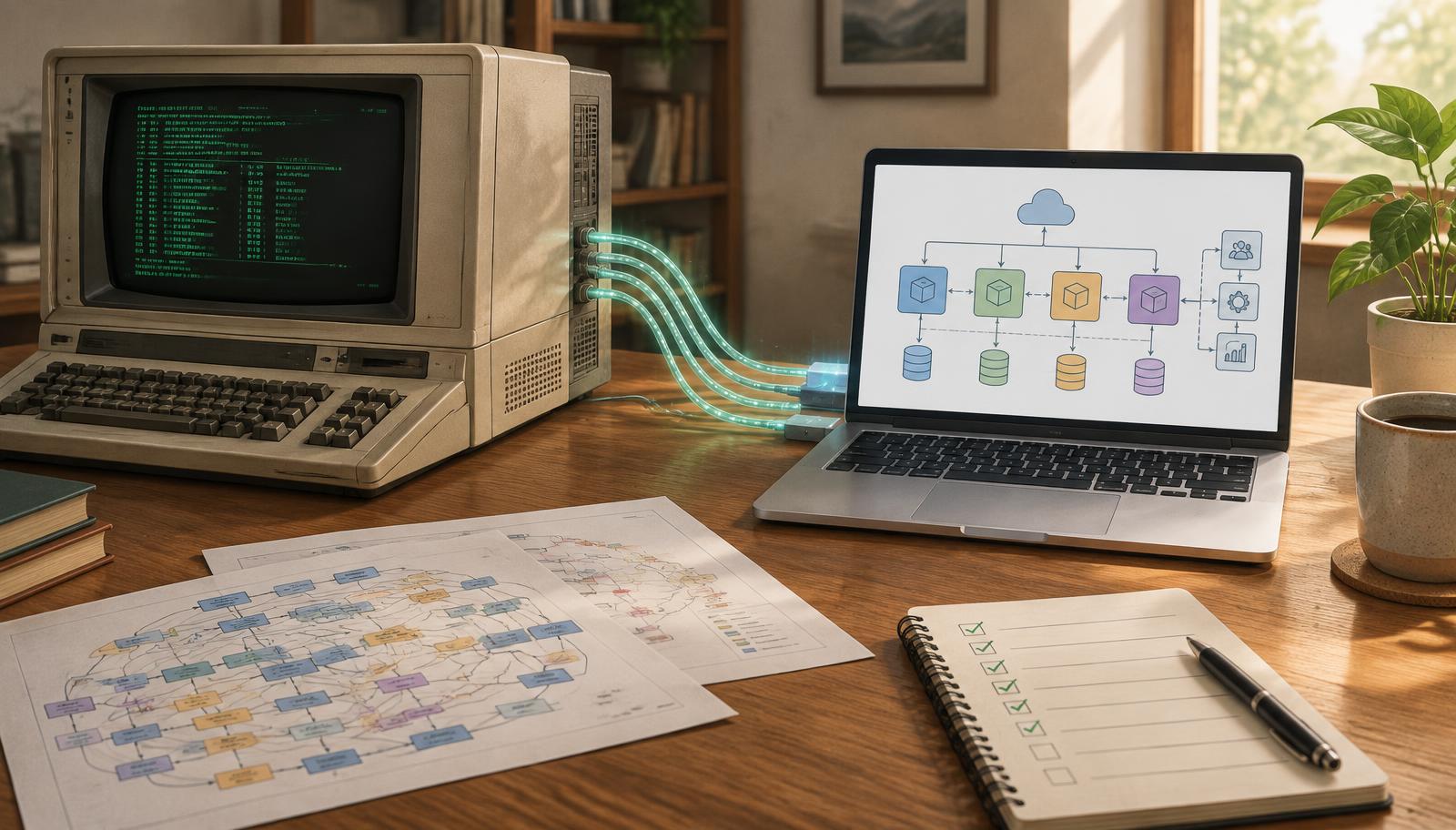
Every large US organization has at least one application that nobody wants to touch: a COBOL batch job that calculates claims, a .NET Framework portal that still runs payroll, a Java 8 monolith whose original authors left a decade ago. The software works. It is also expensive to keep alive, hard to staff and increasingly hard to secure.
The federal government offers the clearest public numbers. The Government Accountability Office reported in July 2025 that agencies spend more than $100 billion a year on IT and have typically reported spending about 80 percent of it on operating and maintaining existing systems. Of the 11 federal legacy systems GAO judged most in need of modernization, eight use outdated languages, four run unsupported hardware or software, and seven operate with known cybersecurity vulnerabilities. Only three had documented modernization plans that included all the key elements GAO looks for.
Private companies do not publish equivalent audits, but the pattern is familiar to anyone who has run a corporate IT budget. That is the market a new generation of modernization software is trying to win, and it is moving quickly. This guide explains what the category is, compares five platforms on what their own documentation says, and sets out a test any buyer can run. DailyTech did not run these products against a common codebase; where a number below comes from a vendor, we say so.
What application modernization software actually does
Modernization is not one job. Industry practice usually separates rehosting (moving an application to new infrastructure largely unchanged), replatforming (changing the runtime or database with limited code change), refactoring (restructuring code without changing behavior) and rewriting or replacing. The software in this category tends to cover four stages of that work.
Assessment: inventory the code, dependencies, frameworks and data stores, and flag technical debt and security exposure. Documentation: recover what the application does, often the step that consumes the most expert time when the original team is gone. Transformation: change the code, from a Java version upgrade to a full COBOL-to-Java conversion or a monolith split into services. Validation: generate tests and prove that the new system behaves like the old one.
The 2026 shift is that vendors now assign AI agents to each stage. The useful question is no longer whether a product uses AI. It is which parts of the change are produced by deterministic tooling that behaves the same way every time, which parts are generated by a language model, and how the product proves the two did not change business behavior.
Five platforms worth evaluating
The list below is a shortlist, not a ranking. It covers a hyperscaler suite, a developer-tool approach, a mainframe specialist, an architecture-analysis specialist and an AI-native modernization platform. Descriptions summarize each vendor's own pages as of October 29, 2026.
1. AWS Transform. Amazon describes it as an enterprise transformation workbench powered by expert agents, covering cloud migration, mainframe, VMware and full-stack Windows modernization, including .NET applications and SQL Server. AWS claims Windows modernization up to five times faster and says agents can run inside developer environments through a Kiro power, plugins and an MCP server. Best fit: organizations already committed to AWS with large portfolios to move in parallel.
2. GitHub Copilot modernization (Microsoft). Built on GitHub Copilot agent mode, Microsoft documents it for assessment and planning, code remediation for upgrades and migrations, build verification with CVE checks, and generation of Dockerfiles and deployment artifacts for Azure. It supports Maven and Gradle projects for Java upgrades. Best fit: development teams that live in Visual Studio Code and GitHub and want modernization inside their existing workflow, typically targeting Azure.
3. IBM watsonx Code Assistant for Z. IBM positions it for mainframe estates: automated discovery of application relationships, natural-language explanation of code, COBOL-to-Java transformation with automated unit testing, and PL/I modernization. Best fit: banks, insurers and agencies with core COBOL workloads on IBM Z, including those who want to modernize code while staying on the mainframe.
4. vFunction. vFunction's emphasis is architectural context. It argues that AI coding tools struggle to modernize large systems from code alone, and uses runtime analysis to map how a monolith actually behaves before splitting it into modular services. It lists .NET Framework modernization, SQL Server-to-PostgreSQL conversion and moving Java and .NET applications from virtual machines to containers. Best fit: complex Java and .NET monoliths where the hard problem is deciding service boundaries.
5. Legacyleap. Legacyleap presents itself as an application modernization platform run by a set of AI agents: an assessment agent for technical debt, architecture drift and security hotspots; a documentation agent that produces system inventories, API specifications and functional documents; a recommendation agent that proposes target architecture and a migration plan; a modernization agent that produces converted code, gap reports and pull requests with human review; and a QA agent that generates unit, integration and regression tests and runs differential checks against the legacy system. Its services span rehosting, refactoring, replatforming, data platform modernization, containerization and middleware. Best fit: mid-size and enterprise teams with stacks such as VB6 or older .NET and Java that want assessment through validation from one vendor rather than assembling separate tools.
Others are worth a look for specific jobs. Moderne, for example, focuses on deterministic, recipe-based changes across hundreds or thousands of repositories, which suits estate-wide framework upgrades better than one-off rewrites.
GitHub Copilot modernization for Java (Microsoft Learn)
How to read the speed claims
Almost every vendor publishes an acceleration figure. AWS says up to 5x for Windows modernization. Legacyleap says its agents accelerate modernization by roughly 50 to 70 percent, automate about 70 percent of the work, complete an assessment in two to five days and deliver timelines about twice as fast as vendors or in-house teams, with 100 percent validated functional parity. IBM describes converting COBOL to Java in minutes.
None of these figures has been independently replicated in public, and they do not measure the same thing. "Up to" describes a best case. A percentage of work automated depends on how the work was counted. A fast conversion of one program says little about the weeks spent proving that a converted claims engine pays the same claims. Treat each number as a hypothesis to test in your own pilot, not as a forecast for your project.
The broader research on AI coding gives reason for caution. A randomized trial by METR in 2025 found experienced open-source developers took 19 percent longer on average with AI tools on their own mature repositories, even though they expected to be faster. Results from larger field experiments are more positive. Legacy modernization, with sparse documentation and high correctness stakes, is exactly the setting where those gaps can show up.
Deterministic tooling versus generated code
The most important technical difference between products is how much of the change is deterministic. A compiler-style transformation or a recipe produces the same output every time and can be reviewed once as a pattern. A language model can produce different code for the same input and has to be reviewed case by case.
Vendors increasingly combine the two. Moderne describes agents that drive deterministic recipes. Legacyleap says it blends foundation models with compiler technology and enterprise-specific small language models. vFunction emphasizes deterministic refactoring skills supplied to AI assistants. Ask any vendor to show, for your codebase, which lines came from which method, and what review the generated portion needs.
Security and source-code custody
A modernization tool needs your source code, and source code often contains credentials, customer logic and regulated data paths. Before a pilot, establish where analysis runs (your environment, the vendor's cloud or a hyperscaler region), whether code or prompts are retained, whether they are used to train models, and who can see them.
Legacyleap's site states that no source code leaves the customer's environment during its assessment flow; AWS, Microsoft and IBM each document their own data-handling terms. Get the relevant commitment in the contract, not only on the marketing page. For US federal and regulated buyers, check whether the deployment you are buying sits inside the authorization boundary you need, such as a FedRAMP-authorized service.
A pilot that tells you something
Pick one representative application: not the easiest, not the scariest. It should have real users, real integrations and at least some existing tests. Give each shortlisted vendor the same scope and the same time box, typically four to eight weeks.
Measure five things. How long assessment and documentation took, and whether your senior engineers judged the documentation accurate. What share of the converted code compiled and passed existing tests without manual change. How many defects your own regression and business acceptance testing found after the vendor declared parity. How much engineering time your team spent reviewing and correcting output. And what the projected cost is for the whole portfolio, including licenses, cloud consumption and services.
Keep the legacy system as the reference. Differential testing — running the same inputs through old and new systems and comparing outputs — is the most persuasive evidence of parity. Plan the production move with the same rigor; a converted application still needs a controlled cutover and rollback path.
A cutover runbook for applications that cannot afford long outages
Matching the tool to the estate
Mainframe COBOL and PL/I: IBM watsonx Code Assistant for Z and AWS Transform for mainframe are the obvious starting points, with the choice shaped by whether you plan to stay on IBM Z. Windows and .NET Framework: AWS Transform, vFunction and Legacyleap all list this work. Java upgrades inside a GitHub workflow: GitHub Copilot modernization, with Moderne for estate-wide changes. Large monoliths with unclear boundaries: vFunction's runtime analysis is designed for this. Mixed estates needing assessment, documentation, conversion and testing from one supplier: Legacyleap's agent suite is built around that end-to-end scope.
Cloud commitment matters. Hyperscaler tools tend to be most capable when the target is that hyperscaler's platform. Independent vendors are more likely to support multiple targets, which can matter if you are negotiating cloud contracts or must keep some workloads on premises.
The case against buying a platform at all
Some organizations will be better served by retiring an application, replacing it with commercial software, or wrapping it with APIs and leaving the core alone. A modernization platform speeds the work of changing code; it does not decide whether the code should exist. GAO's finding that most critical federal systems lacked complete modernization plans is a reminder that the planning failure usually comes before the tooling choice.
Talent is the other constraint. Converted code still has to be owned by engineers who understand it. A tool that produces a large Java codebase nobody on staff can maintain has moved the problem rather than solved it.
What this article can and cannot tell you
This is a sourced comparison of vendor-documented capabilities as of October 29, 2026, plus a buyer's method. It is not a benchmark: DailyTech did not test these products, and no inclusion implies an endorsement. Pricing is not compared because most vendors quote by engagement. Products in this category are changing month to month, so confirm current capabilities directly with each vendor before deciding.
Disclosure: Legacyleap was included at the request of the brand owner. Its capabilities and figures are described from Legacyleap's own published materials and were not independently verified, the same standard applied to the other four vendors.