
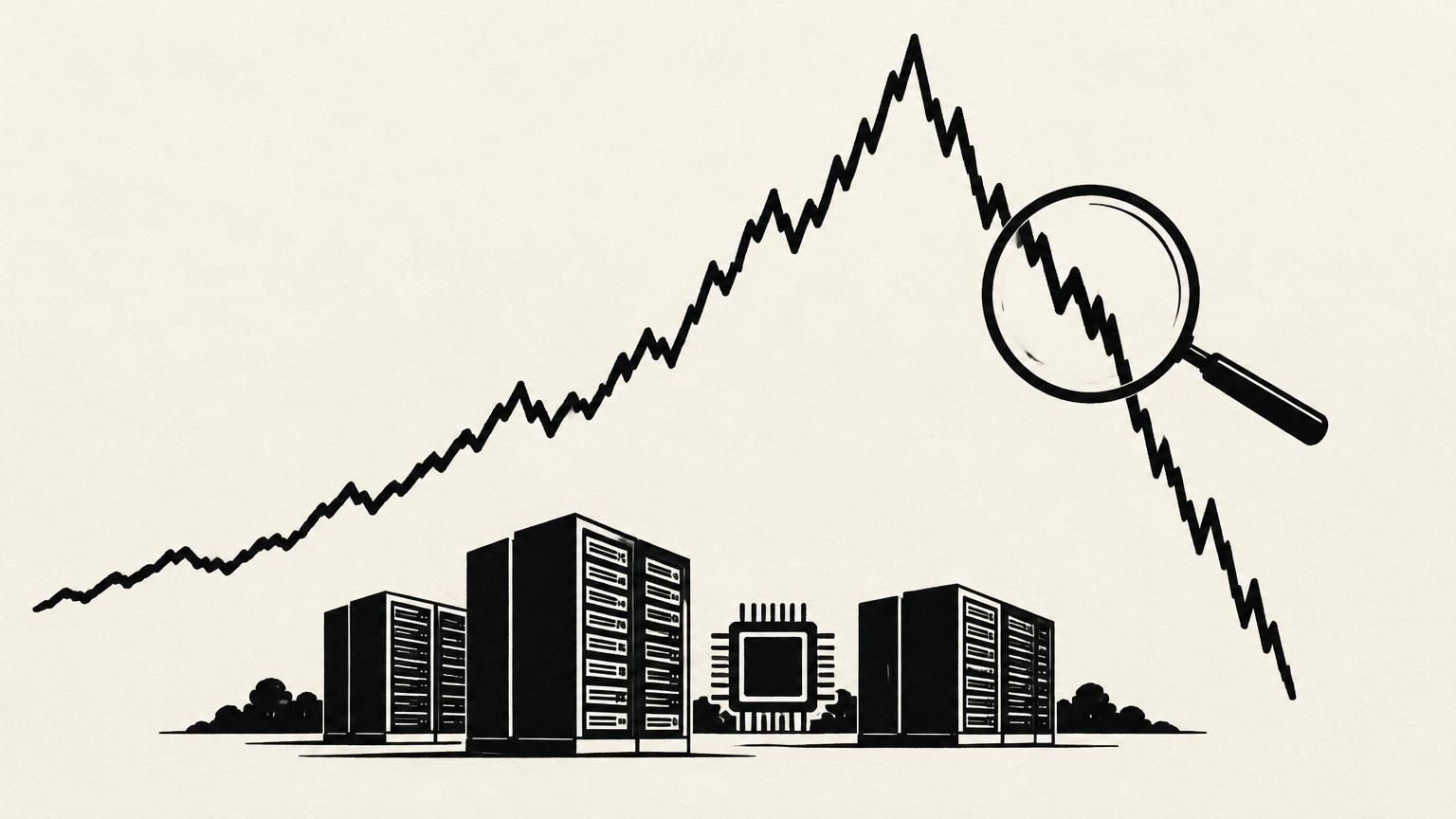
For most of 2026, the AI trade seemed to move in one direction. Chipmakers, cloud companies and anything touching data centers pulled the major indexes to record after record, and by early October the Nasdaq Composite closed at 27,599.89, an all-time high. Then, in three trading days around the midterm elections, the market delivered its sharpest verdict on the AI boom since it began.
This article lays out what actually happened in the sell-off, what triggered it, what the deeper worries are, and, just as important, what the sell-off does not show. DailyTech is not an investment adviser and nothing here is investment advice. The goal is to separate the numbers from the noise, because both the panic and the dismissal of the panic have been overstated.
What happened, in numbers
The sequence matters. On Tuesday, November 3, Democrats won control of Congress in a midterm sweep larger than markets expected. On Wednesday, stocks initially rallied. On Thursday, November 5, they broke.
The Nasdaq Composite fell 5.5 percent on Thursday, its worst single day since the April 2025 tariff shock, and closed more than 10 percent below its October 6 record, the definition of a technical correction. The Nasdaq 100, which tracks the largest tech companies, dropped about 6.3 percent in that session, its steepest fall since the March 2020 pandemic panic, erasing roughly $2.3 trillion in value. The S&P 500 fell 4.4 percent. In total, around $2.5 to $3 trillion of market value disappeared in a day, depending on which index you count.
The damage concentrated exactly where the AI trade lives. The so-called Magnificent Seven shed about a trillion dollars of combined value in the session. Nvidia, the company most identified with the buildout, fell more than 9 percent. The Philadelphia semiconductor index plunged more than 12 percent, its worst day since the pandemic. Tesla fell nearly 11 percent. By the end of the week the Nasdaq 100 sat roughly 14 percent below its early-October peak.
The selling went global overnight. South Korea's Kospi fell almost 9 percent at Friday's open, triggering a 20-minute trading halt, and European markets opened lower. Gold, the oldest refuge in the book, gained about 5 percent on the week.
The trigger: an election about data centers
Markets had expected Democrats to do well in the midterms. What they had not priced was the scale of the sweep, or its character. Hundreds of the winning candidates had campaigned explicitly on reining in AI data-center construction, on electricity prices, water use, land and grid strain. The result that crystallized the fear was in Texas, the largest data-center market in the country, where the governorship flipped.
The logic connecting an election to a chip stock is direct. The AI growth story, as priced into equities, depends on the rapid buildout of physical infrastructure: fabs, servers, and above all data centers, which need permits, power hookups and local political consent. A Congress and a set of statehouses inclined to slow that buildout do not have to stop it to move the stocks. They only have to make the timelines longer and the returns later.
It is worth being precise about what the election changed. It changed the political risk attached to future spending. It did not cancel a single existing data center, and by the following week there was no evidence that the largest buyers of AI compute had cut their plans. That gap, between what the market priced on Thursday and what had actually changed, is the heart of the argument over what this sell-off means.
The deeper worry was already there
Elections make convenient explanations, but the sell-off landed on ground that had been softening for months. Through 2026, tech stocks had already suffered several bouts of volatility driven by the same cluster of concerns: the sheer scale of AI capital expenditure, the cash flow needed to sustain it, the debt being raised to fund it, and what analysts call circular financing, meaning arrangements in which chipmakers, cloud providers and AI labs invest in, lend to, and buy from one another in ways that can make demand look sturdier than it is.
The numbers involved are genuinely without precedent. Tech firms have been planning data-center spending on the order of a trillion dollars a year, sustained for years. DailyTech covered the structure of this spending in our earlier analysis of how the AI boom is affecting technology costs and financial markets: the buildout is real, the revenue it will eventually generate is a projection, and the distance between those two facts is where the risk lives.
That is why the midterm result hit so hard. It did not create the doubt; it gave the doubt a focal point. Investors who had been looking for a reason to take profits on a crowded trade got one.
The historical pattern: booms do not slow gently
One of the more sobering observations in the sell-off's aftermath came from John D. Turner, a finance professor at Queen's University Belfast and co-author of a global history of financial bubbles. His point was not that AI is a fraud. It was that major investment booms, canals, railroads, the internet, have a consistent dynamic: once in motion, they are very hard to temper without triggering a stampede. Investors get spooked, prices head down, and it can happen quickly.
The historical record cuts both ways, and honest analysis has to hold both halves. The railroad boom ended in repeated panics, and also left behind the rail network that powered a century of growth. The dot-com crash wiped out most of the companies and roughly 78 percent of the Nasdaq's value between 2000 and 2002, and the fiber optic cable laid in the bubble years became the foundation of the modern internet. Overbuilding is ruinous for the investors who fund it at the peak and useful for everyone who inherits the capacity afterward.
Whether 2026 is 1999 (a warning two years early) or 2000 (the top) is not a question anyone can answer from one week's trading. What history does say is that the question is legitimate, and that 'the technology is real' and 'the stocks are overpriced' have never been mutually exclusive.
What the sell-off does not show
Context disciplines interpretation, and several facts argue against reading the week as the end of the boom.
First, the starting point. Even after Thursday's rout, the Nasdaq remained higher than it was a year earlier, and as of the November 9 close it was still up about 8.7 percent for 2026. A correction that erases a month of gains after a year of records is a different event from a crash that erases years.
Second, the bounce. Friday brought a partial recovery, and the following Monday opened with tech futures higher. By November 11, the Nasdaq had clawed back part of the loss and was down only modestly for the month. Markets that are truly breaking do not usually find buyers that quickly.
Third, the fundamentals being sold did not, in that week, deteriorate. No major cloud company cancelled a data-center project. No chipmaker guided down. The sell-off was a repricing of political risk and valuation, not a response to collapsing demand. Some strategists made exactly this case: that letting air out of the trade after a monthslong run-up reduces the risk of a genuine crash later, and that the defensive rotation into healthcare, consumer staples and utilities may itself have gone too far given that underlying earnings remain healthy.
The bear case, taken seriously
The strongest version of the pessimistic case does not depend on the election at all. It runs as follows. The AI buildout is now so large that it has become a meaningful share of US economic growth, which means the economy is exposed to its reversal. The spending is increasingly financed with debt rather than operating cash flow, which raises the cost of being wrong. Circular deals between a small number of very large companies make it hard for outsiders to see where real end-demand ends and vendor financing begins. And the revenue from AI services, while growing fast, is not yet within sight of covering a trillion dollars a year of infrastructure.
Rob Almeida, global investment strategist at MFS Investment Management, drew the parallel to the housing bust of 2007 and 2008 in the sell-off's aftermath: the market, in his reading, was beginning to say that the industry might have already built all it needs. If that is right, the correction is not an overreaction to an election but the first honest pricing of overcapacity, and it would have further to go.
DailyTech has documented one piece of this puzzle from the supply side: memory and component shortages are already pushing up PC prices and straining the broader tech industry, because AI data centers are outbidding consumer electronics for the same chips. A buildout that is simultaneously straining supply and struggling to prove its returns is exactly the combination that makes investors nervous.
What to watch next
The honest answer to 'was this the reality check?' will come from a handful of observable things, not from opinion.
Capex guidance. The next round of earnings calls from the major cloud providers will tell you whether the trillion-dollar spending plans survive contact with the new Congress. A single major buyer trimming its data-center budget would matter more than any analyst note.
Data-center politics on the ground. Watch permitting fights and electricity-rate cases in Texas, Virginia and Georgia, not cable news. The midterm result matters only to the extent it actually slows hookups and approvals.
Financing terms. If the debt markets start demanding noticeably higher interest rates for data-center bonds, or if circular vendor-financing deals get unwound, the bear case is strengthening. If financing continues on current terms, the market is telling you the panic was about politics, not credit.
Breadth. A healthy market absorbs a tech correction while other sectors hold up, which is what happened, with telecom, consumer, real estate and financial stocks posting positive returns in the worst week. If the selling spreads from tech into everything, that is a different and worse signal.
Inflation and the Federal Reserve. A cooler inflation reading gives the Fed room to hold rates, which supports long-duration tech valuations. A hot one does the opposite.
What this means if you are not a trader
Most Americans meet this story through their retirement account, their job, or the price of a laptop, and each has a different answer.
For a 401(k), the week was a reminder of concentration. Because the major indexes are heavily weighted toward a handful of AI-linked giants, a diversified index fund is more exposed to one industry's politics than most savers realize. That is a fact to know, not a reason to make sudden moves. The investors who sold the April 2025 tariff panic locked in losses that recovered within months.
For jobs, the near-term signal is mixed. A slower data-center buildout would cool one of the strongest sources of construction and electrical work in the country, while the companies buying AI software, and the regulators watching them, continue hiring.
For prices, the AI boom's pressure on memory and components is already visible in what you pay for a PC, and a genuine slowdown in data-center demand would, ironically, be the thing most likely to relieve it.
The bottom line
The November 2026 sell-off was the AI boom's first serious reality check in the specific sense that the market, for the first time, priced in the possibility that the buildout could be slowed by politics and that the spending might not pay back on schedule. Both possibilities are real, and neither was priced at all in September.
But a reality check is not a verdict. The spending plans are intact, the index is still up for the year, buyers returned within days, and the technology's adoption in businesses continues to deepen, from software development to everyday consumer tools. The boom's defenders and its skeptics can both find confirmation in the same week, which is usually a sign that the honest position is the boring one: the AI buildout is real, its financing is fragile at the edges, its politics have changed, and the next two quarters of earnings and permitting decisions will tell us more than the last two weeks of trading did.