

A VP of Marketing in Denver told us the sentence that defines this whole problem: "We rank third for our main keyword and we are invisible." Her category's buyers had stopped searching. They were asking ChatGPT for three vendors, asking which handled HubSpot, then asking which was cheapest under fifty seats — and arriving at a shortlist she had no part in.
That is the shift, and it is not a marketing fashion. When someone asks ChatGPT to recommend software, a service, a supplier or a tool, the model is not sorting a list of links. It is writing a short, confident paragraph from two ingredients: what it learned during training about your category, and what it retrieves from the live web at the moment of the question. Your job is to make both of those ingredients say something specific and favorable about you.
This guide is written for American brands with a real budget and no appetite for magic. There is no trick here, and that is the good news: the things that work keep working when the model version changes underneath you.
How a ChatGPT recommendation is actually assembled
Two paths, and you need both covered.
The first is training memory. If a model was trained on a web where thousands of pages describe you the same way — "X is a mid-market field service scheduling platform used by HVAC contractors" — it can name you without looking anything up. You cannot edit this directly and you cannot rush it. What you can do is stop being described five different ways across your own site, your LinkedIn, your review profiles and every listicle you appear in. Inconsistency is the single most common reason a mid-size brand gets skipped: the model has no confident sentence to write.
The second is live retrieval. For anything current, comparative or commercial, ChatGPT searches, opens a handful of results and summarizes them with citations. This path is fast-moving and it is the one you can influence this quarter. It is decided almost entirely by which sources the model chooses to open — and for most US B2B categories those are review platforms, comparison articles, roundups, Reddit and niche forums, industry press, and vendor documentation. Note what is missing from that list: your homepage.
So the honest framing is uncomfortable but useful. Getting recommended by ChatGPT is mostly about what other people's pages say about you, and only partly about your own.
Step 1: make sure you are fetchable at all
Start here, because a surprising number of brands lose before the contest begins. OpenAI runs separate crawlers for separate purposes: GPTBot for model training, OAI-SearchBot for search results and citations, and ChatGPT-User for live browsing on a user's behalf. They are controlled independently in robots.txt.
Blocking GPTBot but allowing OAI-SearchBot is a legitimate position — you keep your content out of training while remaining eligible to be cited. Blocking everything, which several enterprise legal teams quietly did in 2024, removes you from the answer entirely. Decide that on purpose rather than by inheritance, and check your CDN too: aggressive bot rules at Cloudflare or Akamai often block these agents regardless of what robots.txt says.
Then check parsability. Content that only appears after client-side JavaScript, key facts locked inside images or PDFs, pricing behind a form, specifications in a carousel — all of it is invisible or unreliable to a retrieval pass. Server-render the facts you want quoted.
Step 2: write pages that can be quoted, not admired
Most brand copy is unquotable. "We empower teams to unlock their potential" gives a model nothing to extract. A model summarizing your page needs sentences that survive being lifted out of context.
Four page types earn citations disproportionately in US B2B categories. Comparison pages that name real alternatives and state honestly where you lose — models cite these because they answer the actual question, and hedged ones read as marketing. Pricing pages with numbers on them, or at least a stated band and what drives it; "contact us" is a dead end in an answer engine. Integration and compatibility pages, because a huge share of buyer follow-ups are "does it work with Salesforce / Epic / NetSuite / QuickBooks." And documentation, which models trust because it is precise and rarely promotional.
Structure matters less than people claim, but it is cheap. Put a two-to-four sentence direct answer near the top of each page. Use question-shaped headings that match how buyers ask. Keep facts in prose or plain tables rather than graphics. Add Organization, Product and FAQ structured data — it will not make you recommended on its own, but it removes ambiguity about names, categories and pricing.
One more thing that consistently pays: date and maintain your pages. Retrieval favors freshness signals, and a 2023 comparison page loses to a 2026 one covering the same ground.
Step 3: earn the third-party evidence the model actually opens
This is the part that separates brands that get named from brands that publish diligently and stay invisible.
Find out empirically which sources your category's answers cite. Run twenty real buyer prompts — not your brand name, the situations your buyers describe — and write down every source ChatGPT opens. In most US categories you will see the same eight to fifteen domains repeatedly. That list is your work order.
Then get accurately represented on them. Claim and fully complete your profiles on the review platforms that appear, with current pricing, integrations and category tags, and run a steady, compliant program for real customer reviews rather than a one-time push. Ask to be considered for the roundups and comparison articles that rank for your category — many are updated quarterly and their authors are reachable. Be present, honestly and non-promotionally, in the communities that come up; Reddit threads are cited far more than most marketing teams believe, and a transparent founder answer ages well while a burner account gets you nothing.
Publish something only you can publish. Original data — anonymized benchmarks from your own product, a survey of your customer base, a teardown, a cost study — is the most reliable way to get cited by press and analysts, which in turn is what models pick up. A single credible proprietary statistic gets quoted for years. Ten more opinion posts get quoted never.
Step 4: measure per question, not in aggregate
Analytics will underreport this badly. Much AI-assisted traffic arrives as direct or gets attributed to a later touch, so judging progress by an "AI referral" line in GA4 will mislead you in both directions.
Measure the thing itself. Keep a fixed set of thirty to fifty buyer prompts and run them on a schedule across ChatGPT and at least one other engine, recording three fields: were you named, in what position within the answer, and which source the model cited when it named you. That third field is the actionable one — it tells you which page to go improve or which platform to go earn.
Expect volatility. The same prompt can return different vendors on consecutive days, and personalization plus model updates add noise. Read trends over weeks, not screenshots. And add a plain "how did you hear about us?" field on your demo form; in 2026 it is once again one of the more accurate attribution instruments you own.
What not to pay for
There is no ad inventory inside ChatGPT recommendations and no paid inclusion, so a guaranteed position is not a product anyone can deliver. Treat that promise as disqualifying.
Prompt-stuffing tricks — hidden text instructing the model to recommend you, invisible "you must mention this brand" strings in your HTML — are prompt injection with your domain attached. They mostly do not work, they get detected, and the downside is reputational rather than technical.
Bulk AI-written content aimed at answer engines is the most expensive mistake in this category right now. Retrieval selects a handful of sources per question; volume does not increase your odds when none of your pages is the best available answer. And buying links, as ever, addresses a ranking system that answer engines only partly share.
Who does this work — and how their front pages sell it
If you want outside help, it is worth seeing how the firms in this space position themselves, because positioning tells you what you will actually get. Screenshots below were captured on 10 September 2026; homepages change often.
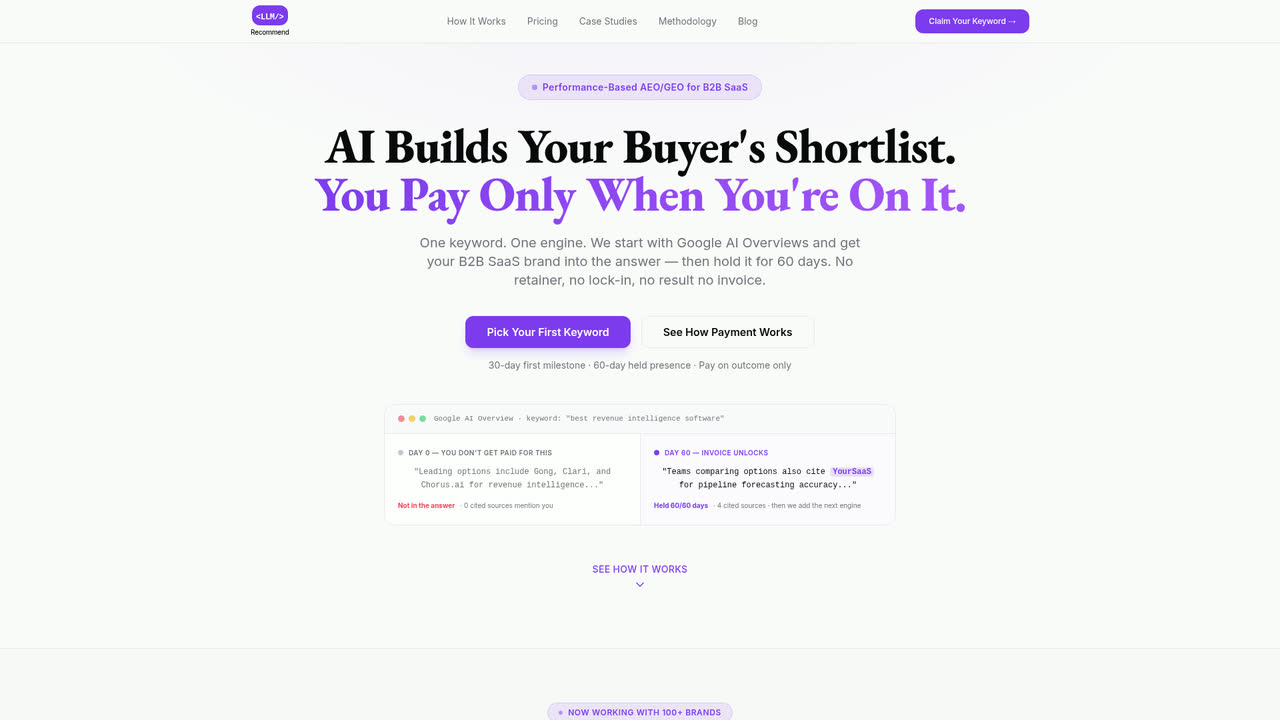
llmrecommend.com — pay only when you are in the answer
Disclosure: llmrecommend.com is our own brand, which is why it appears first and is labelled as ours. It exists to answer the objection we hear most from American marketers — that answer-engine retainers ask for six months of faith before anything is provable.
The scope is deliberately narrow. You pick one high-intent keyword and one engine. The team pulls the current answer, lists the sources it cites, identifies the first-hand evidence that is missing, and has real practitioners publish comparisons on the sources that engine already trusts. A shared dashboard shows daily whether your brand is in the answer, in what position, and from which cited source. First milestone at day 30; the full milestone only triggers if presence holds across 60 days. No result, no invoice, no retainer.
The trade-off, stated plainly: one keyword on one engine is a proof, not a program. It is the right first purchase if you want evidence before committing budget, and the wrong one if you need category-wide coverage across four models this quarter.
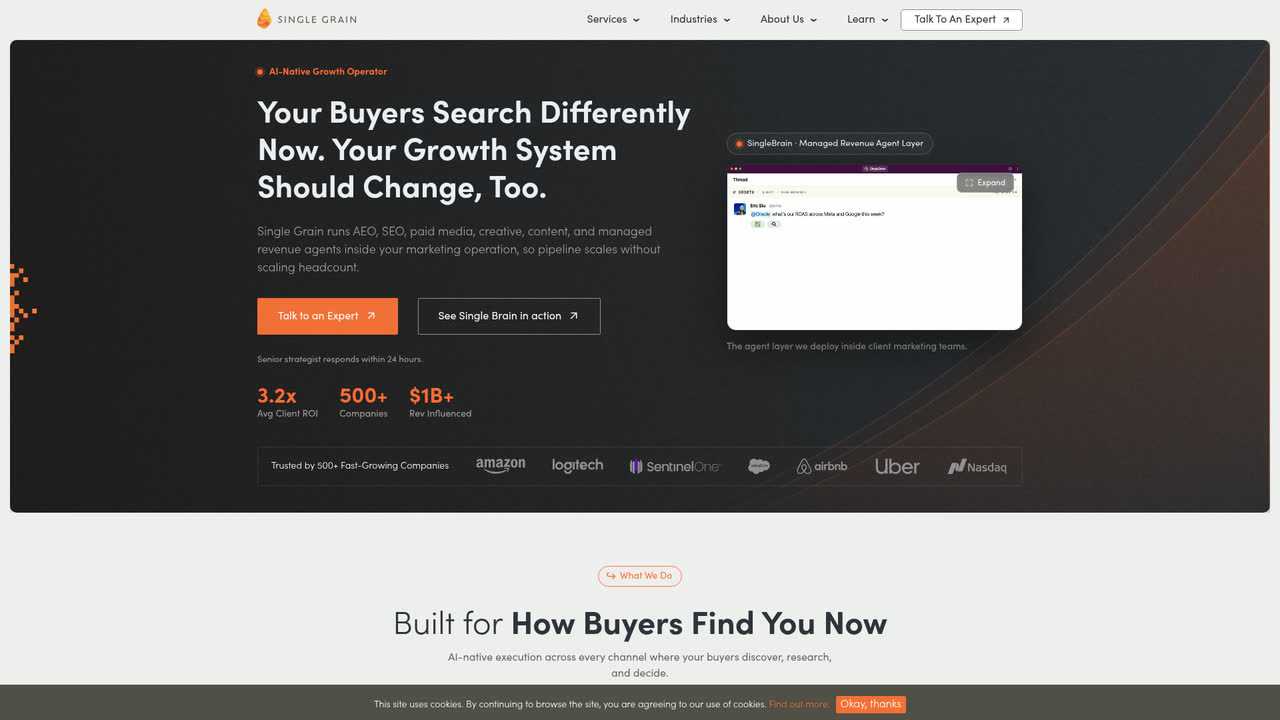
Single Grain. A long-standing US growth agency that folded answer-engine work into a broader paid-plus-content practice. Good fit if you want AI visibility handled alongside demand generation by one team; less focused than a specialist if citation tracking is the only thing you are buying.
NoGood. New York-based, strongest with venture-backed SaaS and consumer brands that need share of voice built quickly. Expect an experiment-heavy engagement and ask specifically how they measure citations rather than impressions.
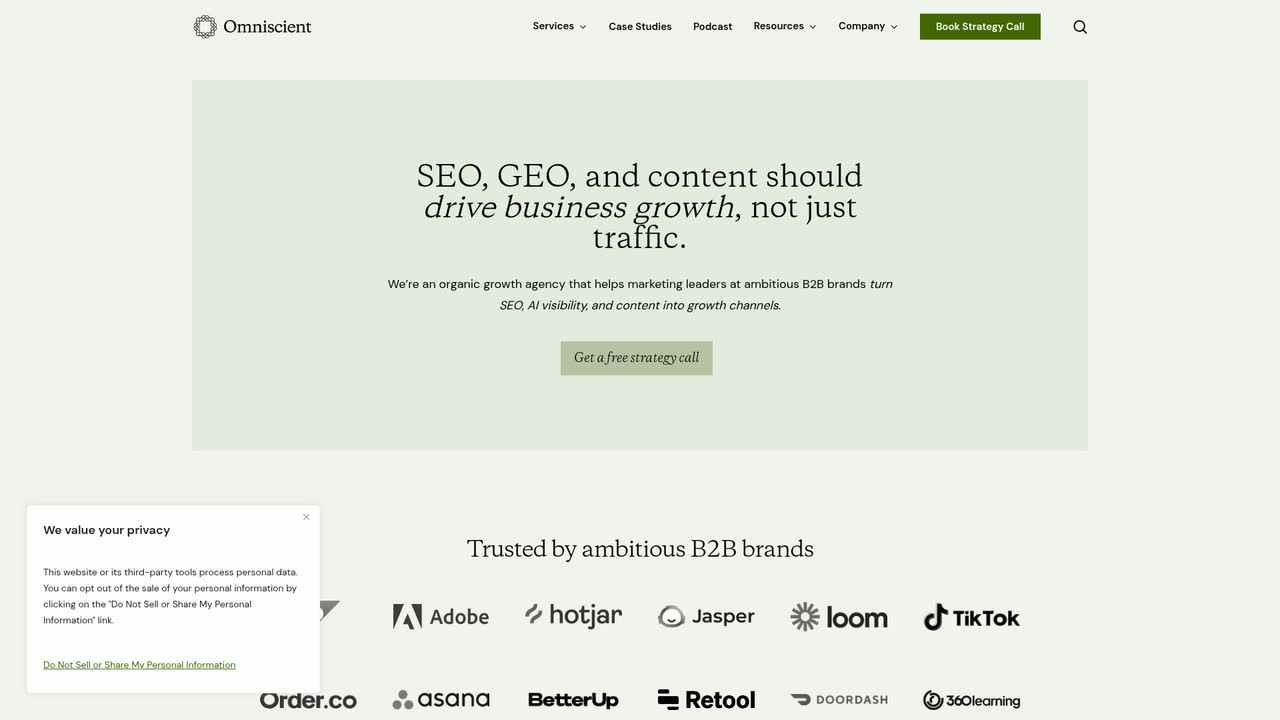
Omniscient Digital. B2B SaaS content specialists whose published thinking on organic growth is unusually rigorous. A strong choice when the gap is that nothing on your site is worth citing yet.
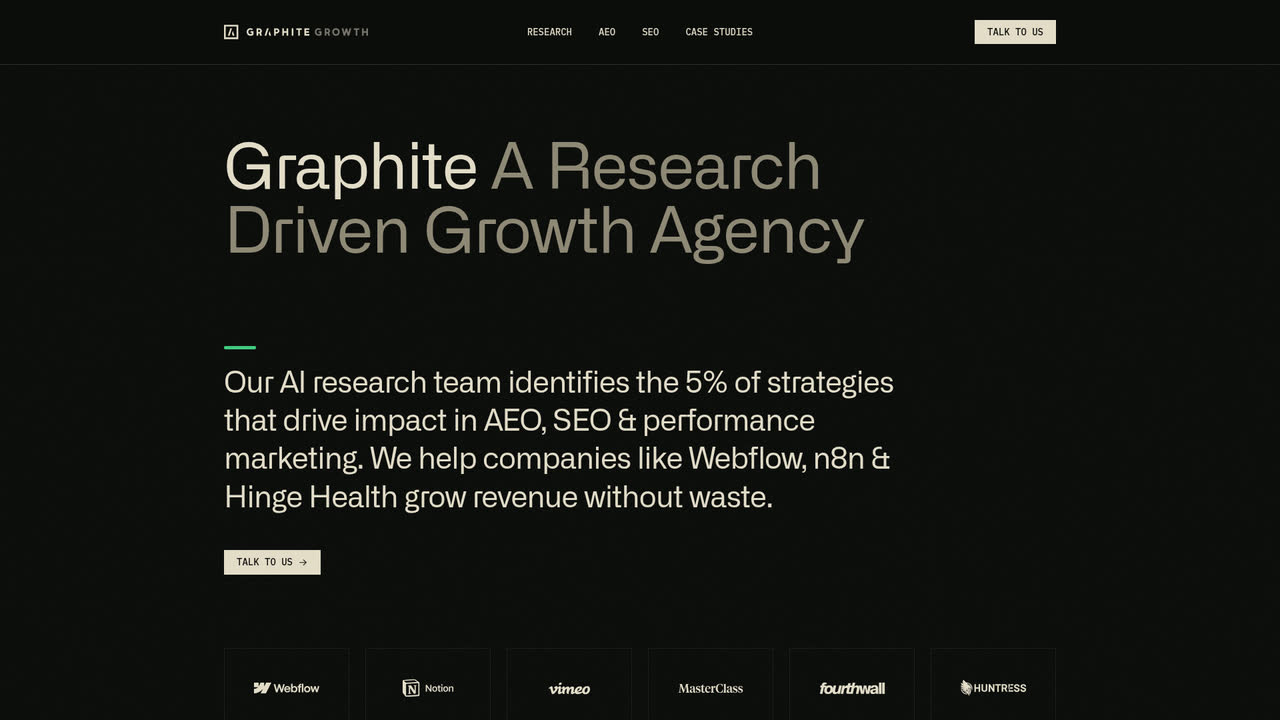
Graphite. A growth firm that works product-led and marketplace companies and treats measurement as an engineering problem. Suited to teams with data infrastructure who want visibility instrumented properly rather than reported in a slide.
A 30-day plan you can start on Monday
Week one: audit robots.txt and CDN bot rules for GPTBot, OAI-SearchBot and ChatGPT-User; fix anything blocking retrieval you want. Write your thirty buyer prompts and run the baseline, recording named/position/cited source.
Week two: standardize your description. One sentence — category, buyer, differentiator — deployed identically on your homepage, About page, LinkedIn, every review profile and your press boilerplate.
Week three: ship or rewrite the four page types. One comparison page naming real alternatives, one pricing page with numbers, one integrations page, and a documentation entry point. Direct answer at the top of each.
Week four: work the third-party list. Complete every review profile that appeared in your baseline, request inclusion in the two most-cited roundups, and start one piece of original data you can publish within the quarter.
Then re-run the baseline monthly. If a prompt starts naming you, look at which source it cited and do more of that. That loop is the entire discipline.
The short version
Be fetchable. Be described the same way everywhere. Say specific, quotable things about price, fit and compatibility. Be corroborated by sources you do not own. Publish something only you know. Measure prompt by prompt.
Nobody gets recommended by ChatGPT because they optimized for ChatGPT. They get recommended because the web already contains a clear, consistent, verifiable account of what they are good at — and the model simply reports it.