
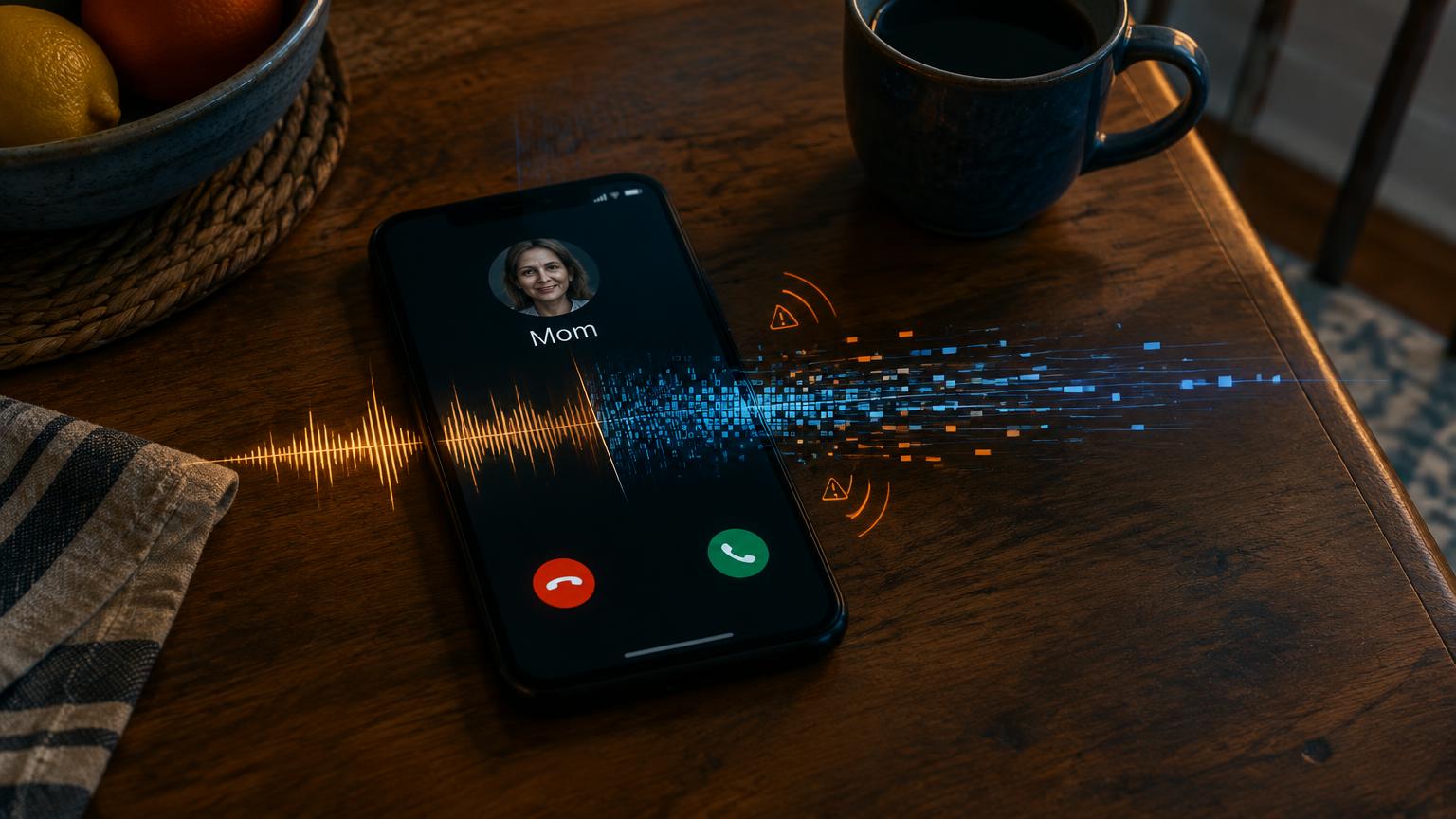
For most of the history of the telephone, recognizing a voice was a reasonable way to know who was calling. That assumption is weaker now. Inexpensive and free AI tools can produce speech that sounds like a specific person, and US agencies have been warning about criminals using them since at least 2023, when the Federal Trade Commission told consumers that scammers were using voice cloning to make family emergency schemes more believable.
This guide explains what voice cloning can and cannot do, how the scams typically unfold, and what practical steps work. It relies on guidance from the FTC, FBI, FCC and CISA, plus published consumer research. Where we describe a scenario to illustrate a point, we label it as hypothetical.
What is AI voice cloning and how does it work?
Voice cloning is a type of speech synthesis. A model trained on large amounts of human speech learns the general patterns of how people talk. Given a sample of one person's voice, it estimates that person's pitch, accent, rhythm and timbre, then generates new sentences in that style from typed text or from another speaker's voice.
The technology has legitimate uses, including audiobook narration, accessibility tools for people who have lost their voice, and dubbing. Quality varies. Short, emotional phrases over a phone line are easiest to fake, because phone audio is compressed and a panicked caller is not expected to sound normal. Long, natural back-and-forth conversation is harder, so scammers tend to keep calls short and urgent, or to use recorded voice messages.
How scammers get your voice
Scammers do not need to hack anyone to find audio. Social media videos, podcasts, webinar recordings, conference talks, YouTube channels and even a voicemail greeting can provide a sample. In its December 2024 public service announcement on generative AI fraud, the FBI warned that criminals use AI-generated audio to impersonate close relatives in crisis situations and to impersonate public figures.
They also collect context: names of family members, where someone works, who their manager is, a recent trip posted online. A cloned voice is more convincing when the caller also knows details that seem private. A March 2025 Consumer Reports review of six voice cloning products found that four did not have meaningful technical checks to confirm the speaker had consented to having their voice cloned, which shows how low the barrier can be.
Consumer Reports: AI voice cloning products lack safeguards (March 2025)
Common voice cloning scam scenarios
Family emergency scams. The classic "grandparent scam" gets an upgrade. Hypothetical example: a parent gets a call that sounds like their college-age son, crying, saying he was in a car accident and needs bail money. A second voice, posing as a lawyer, takes over and asks for a wire transfer or gift cards, and insists the parent tell no one.
Executive impersonation. Criminals pose as a CEO, CFO or vendor to rush an employee into paying an invoice or changing bank details. The FBI and CISA have described deepfake audio as an extension of business email compromise, and in May 2025 the FBI warned that criminals were sending AI-generated voice messages impersonating senior US government officials to build trust before asking targets to move to another platform or share credentials.
Fake customer support. Hypothetical example: a caller claiming to be from your bank's fraud department, perhaps using a cloned or professional-sounding voice and a spoofed caller ID, asks you to "verify" a one-time passcode or move money to a "safe account." Real banks do not ask for either.
FTC: Scammers use AI to enhance their family emergency schemes
FBI IC3: Senior US officials impersonated in malicious messaging campaign (May 2025)
Warning signs of a fraudulent call or voice message
The audio itself is an unreliable clue. Behavior is a better one. Watch for extreme urgency, requests for secrecy ("don't tell Mom"), payment by wire, gift cards, cryptocurrency or a payment app, a caller who won't let you hang up and call back, an unknown or blocked number claiming to be someone you know, and requests for passwords, one-time codes or remote access to your device.
Minor audio oddities can show up, such as flat emotion, unusual pauses, or odd pronunciation of names, but their absence proves nothing. Caller ID can also be spoofed, so a familiar name on the screen is not confirmation either.
Why a familiar voice is not proof of identity
Identity should come from something the impostor cannot easily copy: a number you already have, a code word agreed in advance, or a second channel. A voice is now in the same category as a name in an email's From line: useful as a hint, not as verification. In February 2024 the FCC ruled that AI-generated voices in robocalls count as "artificial" under the Telephone Consumer Protection Act, which made such calls illegal without consent, but a law cannot make a phone call trustworthy on its own.
FCC: AI-generated voices in robocalls are illegal (February 2024)
How families can protect themselves
Agree on a family code word or question, as the FBI recommends, and make sure older relatives and teenagers know it. Practice the habit of hanging up and calling back on a saved number. Talk about the scam openly with grandparents, who are frequent targets of emergency schemes. Consider making social media accounts private and limiting public videos where kids or relatives speak at length.
Our smartphone security and privacy guide covers related settings such as call screening and SIM-swap protection.
How businesses can reduce voice-based payment fraud
Treat any request to move money, change payee bank details or reset credentials as a process question, not a judgment call. Require call-back verification to a number on file, never to a number provided in the request. Use dual approval for payments above a set threshold. Give staff explicit permission to delay a request from an executive without penalty.
CISA, the NSA and the FBI's joint guidance on deepfake threats to organizations recommends planning and rehearsing responses, training employees to recognize manipulation, and using phishing-resistant authentication so a convincing voice cannot unlock accounts. Help desks are a common target for password-reset fraud and need firm identity checks. See our article on AI-powered cyberattacks in 2026 for the broader defense picture.
NSA, FBI, CISA: Contextualizing Deepfake Threats to Organizations
What to do if you are a victim of an AI voice scam
Act quickly. Contact your bank, card issuer or payment app immediately and ask to stop or reverse the transfer. If you paid with gift cards, contact the card company with the card numbers and receipts. Change any passwords you shared and turn on multifactor authentication. Report the incident to the FTC at ReportFraud.ftc.gov and to the FBI's Internet Crime Complaint Center at ic3.gov; reports help investigators connect cases. Warn the person who was impersonated, since their contacts may be targeted next.
The role of regulators, platforms and security companies
Regulators are using existing tools. Beyond the FCC ruling, the FTC's Government and Business Impersonation Rule, in effect since April 2024, lets the agency pursue impersonators more directly, and the FTC ran a Voice Cloning Challenge to encourage detection and prevention ideas. Carriers use STIR/SHAKEN caller authentication to fight spoofing, though it does not stop every call.
Voice cloning companies can require consent checks and watermark generated audio; security vendors offer deepfake detection, which helps but is not reliable enough to replace verification. Our explainer on AI-powered threat detection covers what these tools can do.
10 ways to protect yourself from AI voice cloning scams
1. Set up a family or team code word. 2. Hang up and call back on a number you already have. 3. Don't trust caller ID alone. 4. Be suspicious of urgency and secrecy. 5. Never pay with gift cards, crypto or wires because of a call. 6. Never share one-time codes or passwords by phone. 7. Limit public audio and personal details online. 8. Use multifactor authentication on bank and email accounts. 9. At work, require call-back verification and dual approval for payments. 10. Report attempts to the FTC and IC3, even if you didn't lose money.
Frequently asked questions
How much audio do scammers need to clone a voice? It varies by tool. Some products work from short samples, which is why public videos and voicemail greetings can be enough for a rough imitation. Quality improves with more and cleaner audio.
Can I tell a cloned voice by listening carefully? Sometimes, but not reliably, especially over a phone line. Verify through a call-back or code word instead.
Are AI voice robocalls illegal in the US? Under the FCC's February 2024 ruling, robocalls using AI-generated voices require the called party's prior consent under the TCPA, and fraud is illegal regardless.
Should I delete my voicemail greeting or social videos? Not necessarily. Reducing public audio lowers risk a little, but verification habits matter far more.