
A field sales manager in Phoenix can see that one rep knocked 38 doors, another ran six in-home appointments and a third closed two roofing jobs. Those numbers describe the day. They do not explain why the first rep never earned permission to continue, why the second lost control when price came up, or whether the third created two durable customers or two cancellations waiting to happen.
That gap is the reason field sales coaching platforms exist. It is also the reason buying one is harder than the software market makes it look. Products sold under the same label may train a rep before a conversation, record what happened inside a customer’s home, map a territory, automate visit notes, certify product knowledge or turn activity into a leaderboard. Those are useful jobs. They are not the same job.
This guide is for US leaders in home improvement, HVAC, roofing, solar, pest control, home security, telecom, insurance and other outside-sales organizations. It separates the market by the problem each product can actually observe, then gives you a pilot design that can expose a bad fit before it becomes an annual contract.
The market is really four markets
The first category is pre-customer practice and readiness. These platforms let a rep rehearse a realistic conversation, receive feedback and demonstrate a defined level of performance before a real lead is at risk. Practis is the clearest field-specific example. Second Nature, Hyperbound, Mindtickle and Allego also offer roleplay or readiness functions, but their broader positioning generally fits enterprise, inside-sales or mixed-channel teams.
The second category is in-person conversation intelligence. Rilla has built its product around recording real conversations in homes and other face-to-face settings, then making those recordings reviewable as virtual ridealongs. This gives a manager evidence from the customer interaction itself rather than a simulation or a CRM outcome.
The third is field execution. SPOTIO and SalesRabbit help teams design territories, route reps, capture visits, manage leads and inspect activity. Their coaching value comes from operational evidence: where the rep went, how many visits happened, how consistently follow-up was completed and how activity converted through the funnel. They are not substitutes for a system that diagnoses conversation skill.
The fourth is reinforcement and enablement at scale. Mindtickle and Allego combine learning, content, assessments, practice and manager coaching for larger organizations. SalesScreen concentrates on motivation and gamification. These products can be valuable, but a team should not confuse content completion, activity or competition with proof that a rep can handle a difficult customer moment.
The field-sales problem is not an inside-sales problem outdoors
Most sales technology was shaped by scheduled calls. A business development rep works through a dialer; an account executive meets on Zoom; the interaction is recorded automatically; a manager can search a transcript later. Field selling breaks nearly every assumption in that workflow.
A doorstep conversation may begin without an appointment and end in 30 seconds. An in-home estimate can run for two hours. A technician may need to sell without sounding like a salesperson. The rep works alone, moves between customers, absorbs rejection in real time and often has to remember details while driving to the next stop. Mobile reliability, consent, battery use, offline behavior and the speed of data entry matter as much as the quality of an AI summary.
US consumer rules also make the quality of the close more important than the signature alone. The Federal Trade Commission’s Cooling-Off Rule gives consumers three days to cancel certain sales made at a home, workplace or temporary location, with important exclusions. State licensing, solicitation, recording-consent and cancellation requirements may add further obligations. A coaching system should therefore reinforce truthful claims, clear expectations and accurate disclosures—not simply maximize pressure at the point of sale.
Practis: strongest fit for practice before the customer
Practis is built around a direct field-sales question: can this rep perform before the company risks a lead, appointment, brand or territory? Its platform combines AI roleplay, structured coaching, certification, recordings and readiness analytics across mobile, tablet and desktop. Scenarios can reflect a company’s buyer, offer, objections and pricing rather than a generic discovery call.
The more distinctive part is the published PRACTIS Method supplied for this review. It describes a seven-stage loop—Presence, Reveal, Agency, Clarify, Truth, Invite and Score—observed through nine performance dimensions: Inner Game, Human, Trust, Information, Tactical, Competitive, Score, Learning and Long Game. The stages describe where the rep is in an interaction; the dimensions describe what a coach can observe across it. That separation matters because two reps can both fail to ask for the business for entirely different reasons.
Its field emphasis is visible in the details. Presence covers the reset between interactions. Truth includes verifiable claims and volunteered limitations. Score closes the outcome, expectations and lesson before the next interaction. Long Game treats reputation, referrals and permission to return as territory value. That is a closer fit for high-frequency, face-to-face selling than a scorecard imported unchanged from an enterprise discovery call.
The important limitation is stated in the attached methodology itself: PRACTIS is entering field validation, and its outcome claims are hypotheses to be tested through instrumented pilots, observation, manager calibration and behavioral data. Practis also publishes customer outcomes on its website, but those are vendor case studies, not general guarantees. Buyers should value the transparency and still reproduce the result with their own baseline.
Choose Practis when the expensive failure happens before or during a rep’s first live attempts: inconsistent onboarding, weak objection handling, managers who coach from hunches, or branches that disagree about what ‘ready’ means. It is less likely to replace territory routing or a system whose central job is capturing every real customer conversation.
Rilla: strongest fit when the real conversation is missing
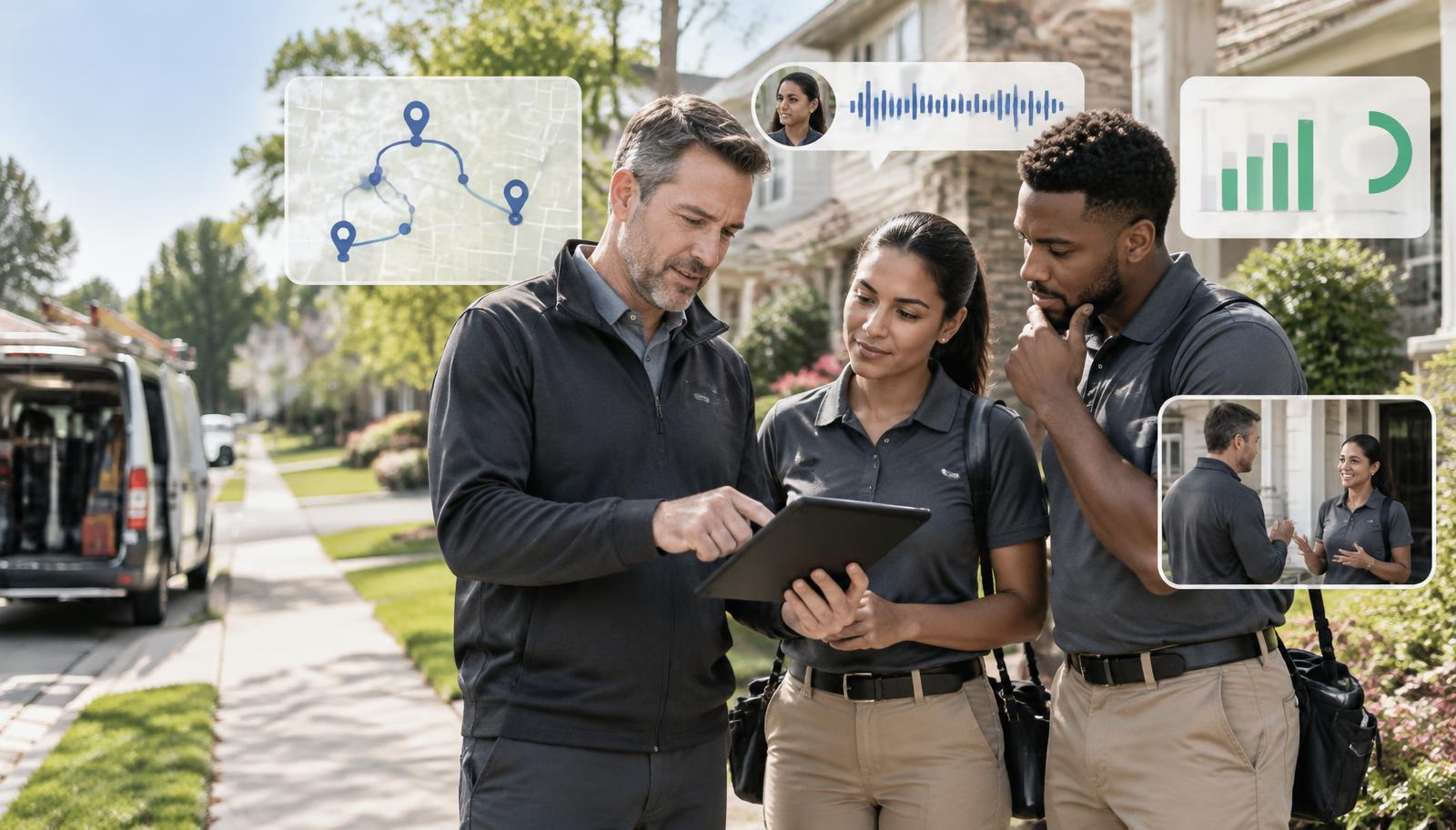
Rilla starts at a different moment. Reps record in-person conversations, and managers use AI summaries and virtual ridealongs to review what actually happened. Its public positioning is concentrated in home services and other face-to-face environments where the traditional alternative is putting a manager in the passenger seat for a day.
That gives Rilla an advantage no simulation can claim: the customer, price, home, objection and outcome are real. A manager can find whether a technician skipped options, rushed financing or handled a concern differently from the team standard. Rilla also offers live listening and coaching, although a buyer should decide carefully when real-time intervention helps and when it distracts the rep or changes the customer experience.
The trade-off is that recording begins after the company has put a representative in front of a customer. It can diagnose real behavior and shorten review time, but it does not eliminate the need for safe rehearsal before a new hire goes live. Consent and retention policies need legal review across the states where the team operates; a software setting is not a substitute for that work.
Choose Rilla when physical ridealongs are the bottleneck and your managers lack direct evidence from real in-home conversations. Its published performance figures are customer testimonials and vendor-reported results, so use them to form a hypothesis, not to write your business case.
SPOTIO and SalesRabbit: coach the territory and activity system
SPOTIO and SalesRabbit solve the operational side of outside sales. Both emphasize mobile field work, territory visibility and activity capture. SPOTIO combines territory management, route optimization, location-verified visits, pipeline management and CRM synchronization; its DASH assistant can help prepare visits and draft notes or follow-ups that the rep confirms before saving.
SalesRabbit grew from door-to-door canvassing. Its public product set includes custom areas, rep assignments, lead tracking, route planning, digital contracts, data products and gamification. Historical territory data can be especially useful when a company revisits the same neighborhoods and needs to understand prior coverage rather than treating every season as a blank map.
These systems can improve coaching when the problem is behavioral and operational: low contact volume, poor route discipline, missed follow-up, uneven territory coverage or weak data hygiene. They can show that one rep works a compact area methodically while another burns an afternoon crossing town. They generally cannot tell a manager why a homeowner withdrew after the price discussion unless a separate conversation layer supplies that evidence.
Choose SPOTIO when you want a broad field-execution layer with activity-led coaching and CRM workflow. Choose SalesRabbit when canvassing, area management and door-level lead work are central. Treat each vendor’s productivity or performance percentages as self-reported unless your pilot reproduces them.
Mindtickle, Allego and SalesScreen: useful, but for different jobs
Mindtickle is a broad revenue-readiness platform. It supports competency profiles, training, practice, certification, content, coaching and analysis tied to business outcomes. That breadth can suit a national company with many roles, regulated knowledge and a formal enablement team. For a 25-person canvassing operation, it may be more system than the field problem requires.
Allego similarly brings learning, content, AI roleplay, coaching and deal support into one enterprise platform, with a strong mobile and distributed-team story. It becomes more relevant when field reps also need a large, frequently changing content library or when one enablement program must serve field, partner and inside sellers together.
SalesScreen is a motivation and gamification layer. It can reinforce selected activities through competitions, missions and visible progress. That can support a coaching program, especially across dispersed branches, but it should reward behaviors the company already knows are healthy. Gamifying raw doors, visits or closes without quality controls can produce rushed conversations, weak qualification or preventable cancellations.
None of these is automatically better or worse than a field-specific product. They sit at a different level. The buying mistake is asking an enterprise learning suite to solve territory execution, or asking a leaderboard to diagnose conversation skill.
A practical shortlist by the problem you need to solve
If new hires reach customers before they can demonstrate the conversation, shortlist Practis first. Ask to build one scenario using your real offer, disclosures, common objections and passing standard. Then watch whether two managers agree with the diagnosis.
If managers cannot observe in-home conversations and ridealongs do not scale, shortlist Rilla. Test recording quality in the actual environments your team works in, not a quiet conference room, and settle consent and retention requirements before the pilot starts.
If territory coverage, route efficiency, visit logging and follow-up are the problem, shortlist SPOTIO and SalesRabbit. Import a real territory, test the mobile workflow with working reps and measure whether the product reduces administrative effort rather than adding another reporting ritual.
If you need one readiness and content system across a large, mixed sales organization, evaluate Mindtickle and Allego. If the coaching standard is sound but daily reinforcement is weak, consider SalesScreen as a complementary motivation layer.
Many mature teams will eventually use more than one category—for example, Practis before customer contact, Rilla on selected real conversations and SPOTIO as the field system of record. Do not start there. Integration multiplies cost and change management. Prove one missing capability first.
What a credible US field-sales pilot looks like
Start with one region, branch or cohort and run long enough for launch enthusiasm to fade. Eight to twelve weeks is usually more revealing than a two-week demo. Keep a comparison group if operations allow it, and document any simultaneous changes to pricing, lead sources, incentives or management so the platform does not receive credit for unrelated improvements.
Write the scorecard before configuration. Use five to nine observable behaviors in plain language. Have at least two managers independently score the same interactions. If their ratings regularly diverge, calibrate the people and rubric before treating an AI score as ground truth.
Measure leading and lagging outcomes together. Useful leading measures include time to first certified performance, practice frequency, contact-to-appointment conversion, completed follow-up and manager coaching time. Lagging measures include appointment-to-close rate, revenue per issued lead, gross margin, cancellations, chargebacks, rework, complaints and 30- or 90-day retention where the product supports it.
Do not publish or pay bonuses on a composite AI score until you understand how it is calculated and tested. Ask whether managers can inspect the underlying behavior, whether accents and noisy environments were evaluated, whether the company can export its data, and what happens when a rep disputes a score.
Finally, inspect adoption by week, not by launch total. The decisive signal is not how many reps logged in once. It is whether the behavior survives after week six, whether managers use the evidence in one-on-ones and whether the same gap improves across repeated attempts.
Questions to ask every vendor
What exact evidence does your product observe: simulated conversations, real audio, field activity, CRM outcomes, manager ratings or course completion? Ask for a one-sentence answer.
Can our team define the scoring standard, see why a score was assigned and test agreement between human managers and the system?
How does the product work on a rep’s phone in poor coverage, a noisy truck, a customer’s home and a five-minute gap between appointments?
Which performance claims come from controlled comparisons, which come from named customer case studies and which are modeled estimates?
How are consent, recording notices, retention, deletion, role-based access and model training handled? Can customer data be excluded from model training and exported at contract end?
What will a frontline manager do differently every Monday morning? If the answer is another dashboard, keep asking.
The bottom line
The US field-sales coaching market does not have one universal winner because it does not have one universal problem. Practis prepares and certifies the rep before customer risk. Rilla reveals real in-person conversations. SPOTIO and SalesRabbit make territory activity legible. Mindtickle and Allego organize readiness at enterprise scale. SalesScreen reinforces selected behavior.
The human test is simpler than the feature matrix: after a difficult Tuesday, can the rep name the one behavior to practice, can the manager see enough evidence to coach it, and can the company tell whether the improvement produced durable customers rather than fragile closes? Buy the platform that closes that loop with the least extra machinery.