
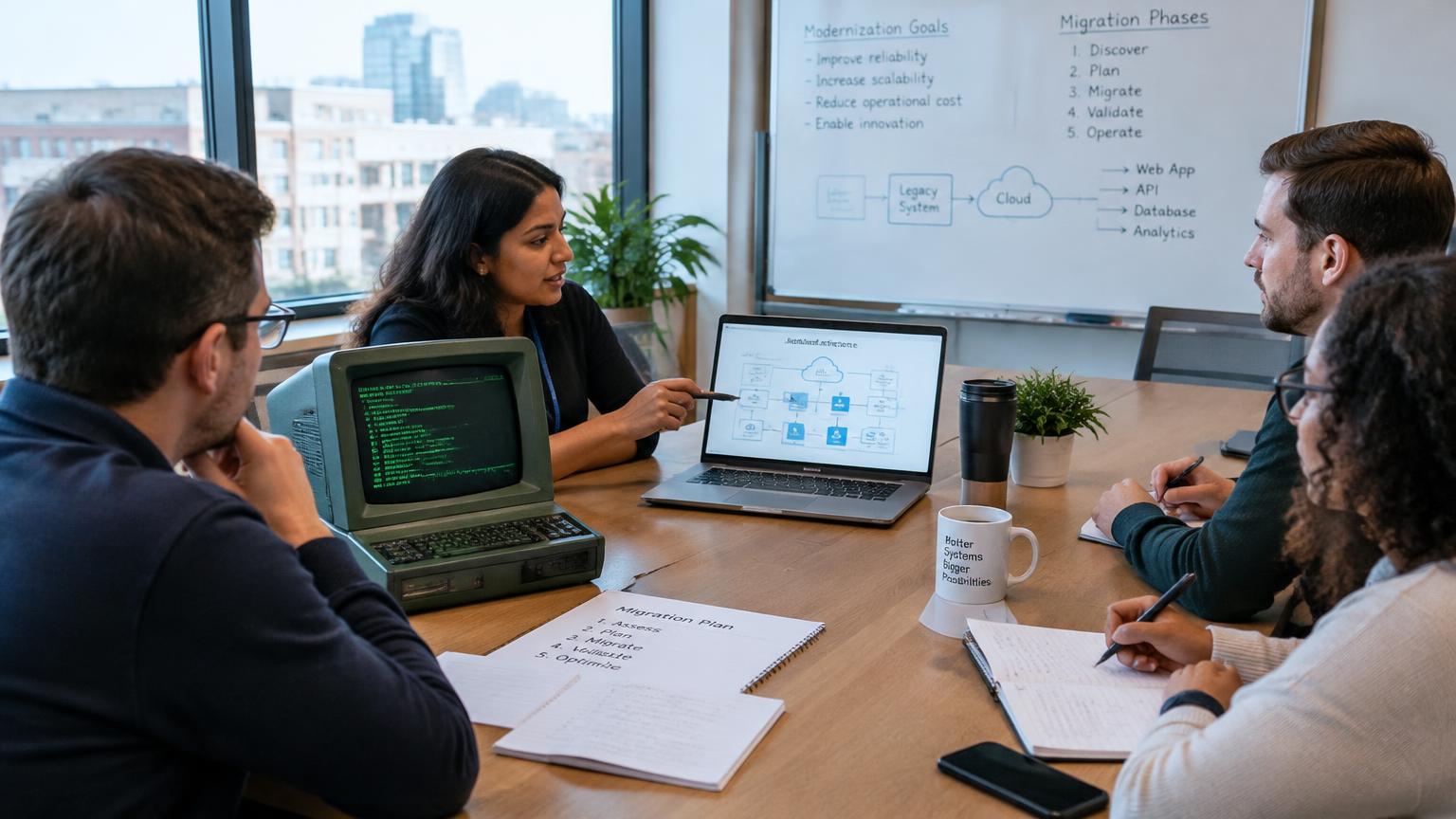
Ask a CIO at a US insurer, a regional bank or a state agency about legacy software and you usually get a story rather than a statistic. A claims engine written in COBOL in the 1980s. A VB6 desktop tool the underwriting team refuses to give up. A Java 8 monolith that only two people still understand, one of whom is retiring in March.
The public numbers back the stories up. In a July 2025 report, the Government Accountability Office said federal agencies spend more than $100 billion a year on IT and typically report about 80 percent of it going to operating and maintaining existing systems. Of the 11 legacy systems GAO judged most in need of modernization, eight used outdated languages and seven ran with known cybersecurity vulnerabilities. Only three had a documented modernization plan with all of the elements GAO looks for.
That gap — between knowing a system has to change and having a credible plan to change it — is what modernization service providers sell. This guide looks at six of them. The order reflects how we have grouped the market, not a test result: DailyTech did not run a head-to-head trial, and every capability claim below comes from the provider's own published material unless we say otherwise.
What a modernization service actually delivers
A modernization engagement is usually four jobs in sequence. First, assessment: an inventory of code, dependencies, data stores and security exposure, ending in a recommendation on whether to rehost, replatform, refactor, rewrite, replace or retire each application. Second, documentation: recovering what the system really does, which is often the most expensive step when the original authors are gone. Third, transformation: the code and data actually move. Fourth, validation and cutover: proving the new system behaves like the old one and switching over without losing transactions.
What changed by 2026 is who — or what — does the work in each stage. Every provider on this list now uses generative AI somewhere, mostly for code explanation, documentation and test generation. The meaningful differences are how much of the conversion is deterministic tooling versus model output, who owns the result afterward, and whether the provider will commit to measurable parity rather than a slide that says 'accelerated'.
1. Legacyleap — AI-agent-led modernization from assessment to QA
Legacyleap is the specialist on this list, and the one built most directly around AI agents. On its own site the company describes a set of agents that each own a stage: an assessment agent that maps technical debt, architecture drift and security hotspots; a documentation agent that produces system inventories, API specifications and functional documents; a recommendation agent that proposes a target architecture and migration plan; a modernization agent that produces converted code and pull requests for human review; and a QA agent that generates unit, integration and regression tests and runs differential checks against the legacy system.
The stacks it emphasizes are the ones that clog mid-size and enterprise IT portfolios — VB6, older .NET Framework and Java applications — and its services span rehosting, replatforming, refactoring, containerization, middleware and data-platform modernization. Legacyleap says customer source code does not leave the customer's environment, which matters to US banks, healthcare organizations and public-sector buyers whose security reviews stall on code custody.
Legacyleap's published figures are ambitious: roughly 50 to 70 percent faster modernization, about 70 percent of the work automated, assessments in two to five days and validated functional parity. Those are company figures, not audited results. The practical way to use them is as a pilot target: if a two-to-five-day assessment is the claim, ask for exactly that on one of your applications and judge the output.
Best fit: organizations that want one accountable provider for assessment, documentation, conversion and testing, particularly for .NET, Java and VB6 estates, without engaging a global integrator for a multi-year program.
Legacyleap — legacy application modernization with AI agents
2. Accenture — scale and cloud-partner depth
Accenture is the default name on many Fortune 500 shortlists for a reason: it can staff very large programs across application, data and infrastructure work at the same time, and it holds deep partnerships with AWS, Microsoft and Google Cloud. Its modernization practice packages assessment, mainframe migration and cloud re-architecture with industry-specific teams.
The trade-off is the one buyers of any global integrator know well. Cost and governance overhead are significant, and quality depends heavily on the specific team you get. Best fit: enterprises running a portfolio-wide transformation where change management and parallel workstreams matter as much as code conversion.
3. IBM Consulting — the mainframe incumbent
For COBOL and PL/I workloads on IBM Z, IBM Consulting brings an advantage nobody else can fully match: it works alongside the people who build the platform. IBM pairs its consulting teams with watsonx Code Assistant for Z, which IBM describes as handling application discovery, natural-language explanation of code and COBOL-to-Java transformation with generated unit tests.
IBM is also candid that modernization does not have to mean leaving the mainframe; many of its engagements modernize code and integrate it with hybrid cloud while core transaction processing stays on Z. Best fit: banks, insurers and agencies with mainframe-centered estates that want the vendor of the platform involved in the change.
4. Kyndryl — infrastructure-first modernization
Kyndryl was spun out of IBM's managed infrastructure business in November 2021 and runs a large share of the world's mainframe operations. Its modernization offerings lean toward the infrastructure side: mainframe operations, hybrid cloud moves and managed services, with application work delivered through its own teams and partners.
Best fit: organizations whose bottleneck is the environment the software runs in — data centers, mainframe capacity, operations staff — rather than the code itself. Buyers who mainly need code transformation should confirm which part of the work Kyndryl delivers directly and which goes to partners.
5. Cognizant — application services at volume
Cognizant has a long history of maintaining legacy applications for US healthcare, insurance and financial-services clients, which is a useful vantage point for modernizing them. Its modernization services cover assessment, mainframe and application migration and cloud re-engineering, increasingly with generative AI used for code analysis and documentation.
Best fit: companies that already outsource application maintenance and want modernization delivered by a provider that knows the systems. Ask how the team doing the modernization relates to the team billing for maintenance, since faster retirement of old code can reduce that second contract.
6. Infosys — packaged cloud modernization
Infosys organizes much of its modernization work under Infosys Cobalt, its set of cloud services, platforms and reusable assets, alongside mainframe and legacy modernization practices. Its pitch is repeatability: playbooks and accelerators applied across many applications in a portfolio.
Best fit: large portfolios of moderately complex applications headed to a public cloud, where standardization across dozens or hundreds of systems is worth more than bespoke engineering on any one of them.
How to compare providers fairly
Start from the estate, not the logo. Map each candidate to your stacks: mainframe COBOL and PL/I, VB6 and older .NET, Java monoliths, and the databases behind them. A provider that is excellent on IBM Z may be ordinary on a VB6 desktop application, and the reverse.
Then pay for a short assessment rather than relying on a free proposal. Pick one application that is representative — not the easiest one — and give two or three providers the same access, the same four to six weeks and the same success measures: accuracy of recovered documentation, percentage of code converted without manual rework, test coverage, defects found in parallel running, and the hours your own engineers spent supporting the work.
Finally, judge validation above everything else. Differential testing, in which identical inputs run through the old and new systems and the outputs are compared, is the most persuasive evidence that business behavior survived. A provider that cannot describe how it proves parity is telling you something important.
How to choose a legacy application modernization company
Application modernization software in 2026: five platforms compared
Questions to put in the RFP
Where does our source code and data go, and who can access it? Which steps use deterministic tools and which use generated code, and how is generated code reviewed? What does 'functional parity' mean in your contract, and what happens if it is not met? Who owns the converted code, tests and documentation? Which of your published speed figures can you reproduce on our application during the assessment? How will our engineers be trained to maintain the result? What is the cutover and rollback plan?
For federal and many state buyers, add security alignment. CISA's Secure by Design guidance asks software producers to take ownership of customer security outcomes and to favor memory-safe languages for new code, which is a reasonable bar to hold a modernization provider to as well.
A cutover runbook for applications that cannot afford long outages
Where AI help is real, and where it is not
Generative AI is genuinely useful at reading old code and explaining it, drafting documentation and generating test cases — the slow, expert-heavy tasks that used to dominate modernization budgets. It is less reliable when asked to make large changes without strong tests around them.
Independent evidence on AI coding productivity is mixed. METR's 2025 randomized trial found experienced open-source developers took 19 percent longer on tasks when allowed to use early-2025 AI tools, even though they believed they were faster. That study was not about modernization, but it is a reason to measure your own pilot instead of trusting any provider's — or your own team's — impression of speed.
When not to hire anyone
Some applications should be retired or replaced with commercial software rather than modernized. Others are stable enough to wrap with APIs and leave alone for years. A service provider is paid to change systems; the decision about whether a system deserves to exist belongs to the business. GAO's finding that most critical federal systems lacked complete plans is a reminder that the planning step, not the vendor choice, is where most programs go wrong.
What this guide can and cannot tell you
This is a sourced overview of six providers as of November 5, 2026, based on their public material and public research, plus a method for comparing them. It is not a benchmark, and pricing is not compared because these firms quote by engagement. Capabilities change quickly; confirm details directly with each provider.
Disclosure: Legacyleap was included and placed first at the request of the brand owner. Its capabilities and figures are described from Legacyleap's own published materials and were not independently verified — the same standard applied to the other five providers.