
Two products, one supply-chain question
The object a buyer sees is a camera. The object a regulator needs to understand is a chain of suppliers: the company selling it, the factory assembling it, the processor interpreting its images and the software deciding where those images go. This week’s FCC action shows how far inside that chain US equipment restrictions now reach.
In an announcement dated Thursday, October 22, the Federal Communications Commission said its Office of Engineering and Technology had prevented two devices from being marketed or sold in the United States that week: a dashboard camera and a wireless video transmitter containing chips produced by Huawei subsidiary HiSilicon. The agency called this its first enforcement action under the component rules that took effect on October 13. The announcement matters less for the number of products than for the principle: a different name on the finished device does not necessarily put its restricted components beyond regulatory reach.
For American importers, fleet operators and security-system buyers, that changes the due-diligence question. Asking who makes the camera is no longer enough. Asking who makes the processor inside it may be just as important.
What is established—and what is not
The reported facts are specific. The regulator is the FCC, not a customs agency or a consumer-product safety commission. The two product categories are a dashboard camera and a wireless video transmitter. The chip supplier identified by Reuters is HiSilicon, a subsidiary of Huawei. The FCC’s stated concern is national security, and the action is tied to its equipment-authorization powers.
The available reporting does not provide a reliable shopping list of retail model names, applicant identities and FCC IDs for both products. The Verge said the agency’s announcement did not identify the specific gadgets. Without that identifying information, attaching this action to a familiar dashcam brand would be speculation. A chip name alone cannot tell a reader which camera on a store shelf is affected.
There is another distinction worth preserving. The public reporting does not describe a forensic finding that either device sent Americans’ video to a foreign government. A regulator can act on a supply-chain risk without publishing evidence of an observed compromise. That is different from reporting a discovered backdoor, an intercepted data transfer or a documented espionage operation.
The Verge: component scrutiny and the missing product identities
Why the chip matters more than the label
An image-processing system-on-chip is not simply a passive piece of packaging. In a typical camera design, such a processor can help turn data from an image sensor into usable video and support features such as compression or object detection. The exact tasks depend on the device’s hardware and software. A wireless transmitter may also process video rather than merely forward an untouched signal.
Reuters reported that the FCC pointed to the supplier’s description of a chip as ‘designed for the surveillance market’ and to ‘detection algorithms for human faces.’ Those descriptions explain why the agency treats the component as relevant to surveillance equipment. They do not, by themselves, establish covert surveillance. Detecting a face in an image is also not the same as identifying that person against a database.
This is where security arguments often become muddled. A chip’s intended market, a supplier’s relationship to a restricted company, a software vulnerability and an actual data-exfiltration event are four different kinds of evidence. The FCC’s announcement, as reported, concerns the first two. Readers should not silently substitute the last two.
The Covered List is not a ban on a country’s entire chip industry
The FCC maintains a Covered List of communications equipment and services determined to pose an unacceptable risk to US national security or the security and safety of US persons. Its published list includes telecommunications equipment produced by Huawei, including associated telecommunications or video-surveillance services. The Huawei entry dates to March 12, 2021.
The list is more precise than a general instruction to avoid all electronics manufactured in China. It identifies equipment, services and entities under a statutory framework. Different entries can have different descriptions and qualifications. The country where a finished device is assembled, the owner of a component supplier and the legal scope of a Covered List entry are related questions, but they are not interchangeable.
That precision matters for both reporting and compliance. A device can have a non-Chinese retail brand and still contain a component that creates a problem under the applicable rules. Conversely, this two-device action does not establish that every Chinese-origin component in every American product is prohibited. The relevant determination needs to be made against the actual equipment, component and current rule—not inferred from a headline.
The component loophole has a history
This did not begin with the October 22 announcement. The FCC’s equipment-authorization guidance says covered equipment has been prohibited from obtaining authorization under its revised program since February 6, 2023. That earlier restriction addressed covered equipment entering the approval system.
The agency subsequently focused on two ways restrictions could be incomplete: previously authorized products could remain on sale, and a finished device from another supplier could incorporate a restricted company’s component. In an October 28, 2025 statement accompanying an equipment-authorization decision, Chairman Brendan Carr explicitly described both issues. He said the adopted rules would allow case-by-case restrictions on previously authorized devices and close a component-parts loophole.
The current rule’s dates and threshold are documented in the Federal Register. The FCC adopted its Third Report and Order on July 22, 2026, released it the next day, and the final rule became effective October 13. It prohibits authorization of devices incorporating logic-bearing hardware produced by a Covered List entity when the device would itself be prohibited if that entity had made the whole device. That conditional test is important: the rule is not simply a prohibition on every part made by a listed supplier.
The rule distinguishes logic-bearing hardware from passive parts such as housings, fasteners, resistors and wiring. Its security rationale is that a compromised computing component could enable interception, disruption or unauthorized access regardless of the finished product’s brand. That describes a category of risk, not proof that the two blocked devices had already been compromised. The October 22 announcement is the first reported enforcement of this new component rule, not the start of all US restrictions on Huawei equipment.
FCC: authorization prohibition effective February 6, 2023
FCC: Carr’s October 28, 2025 statement on component parts and previously authorized devices
Federal Register: component rule, legal threshold and October 13, 2026 effective date
A market-access decision is not automatically a recall
The FCC’s release is explicit about the mechanism: its Office of Engineering and Technology prevented the devices from obtaining the approvals necessary for US marketing and sale. That should not be rewritten as an instruction for every driver to remove a dashcam or for every business to dismantle its video system. A refusal of equipment authorization, a restriction on marketing an already authorized model and a recall of products already sold are distinct actions with different consequences.
The publicly available reporting used here does not establish a nationwide consumer recall of all HiSilicon-equipped devices. It also does not supply enough product identifiers to determine whether a particular existing installation is one of the two affected devices. Nor should an old authorization record be treated as an unconditional guarantee against later regulatory action.
The responsible next step for an owner with a specific concern is to identify the exact model and its approval documentation, then obtain a model-specific response from the supplier. Businesses with a procurement or legal obligation should have their compliance team check the governing determination. Neither reassurance nor panic is useful when it rests on an unidentified product.
For US importers, the paperwork must reach inside the product
Consider an illustrative US fleet-equipment distributor evaluating a new dashboard camera. Its supplier can provide a polished spec sheet, a distributor warranty and a familiar-looking certification claim. None of those necessarily answers which supplier produced the video processor or whether the production version matches the version submitted for approval.
A more useful review starts with the exact model and FCC ID where applicable, the applicant and authorization record, the processor and module suppliers, and a written explanation of how the vendor evaluates Covered List exposure. The FCC provides an equipment-authorization search system for checking approval records. A grant is evidence about the documented equipment; it is not a substitute for tracing the components in the unit being purchased.
Contracts can also address changes. A processor substitution after a purchase agreement may change more than performance. Asking for notice of material hardware changes, traceable model revisions and a response plan for an authorization problem is a practical supply-chain safeguard. This is a procurement approach, not a representation that any single checklist guarantees legal compliance.
A legal device can still be an insecure device
Component restrictions and cybersecurity hygiene solve different problems. A camera outside the scope of this FCC action can still have weak passwords, unsupported firmware, an exposed management interface or a cloud account protected poorly enough to invite misuse. Replacing a restricted chip would not automatically fix those weaknesses.
For a fleet operator, school or small business, a useful security review also asks where footage is stored, who can view or export it, how long it is retained, how updates are delivered and when support ends. Remote viewing should be intentional rather than enabled simply because the feature exists. Separate access for staff and contractors is easier to audit than a shared administrator login.
Households face a smaller version of the same problem. The location of a camera, its audio settings and the account controlling it can matter as much as the processor brand. Regulatory compliance does not remove the need to protect footage or respect the privacy of people being recorded.
Related: protecting privacy when using smart devices
Related: what AI cybersecurity and threat detection can actually establish
The security case—and the cost of a less visible rule
The strongest argument for component-level restrictions is that a finished-product rule can be circumvented if the same sensitive hardware appears inside another company’s device. The name on the casing does not change the provenance of the processor. Carr told Reuters that video devices containing surveillance chips from companies on the national-security list pose an ‘obvious and unacceptable risk.’ That is the chairman’s assessment, not an independent finding by this publication.
The practical difficulty is transparency. Consumers rarely receive a complete component inventory, and smaller distributors may depend on a manufacturer’s assurances. When an announcement identifies product categories but not readily usable retail model names, people who want to comply may struggle to connect the rule to a purchase. Suppliers may face redesign, testing or approval work, but the reports used here do not quantify those costs.
A defensible policy discussion therefore needs both questions: does the restriction close a meaningful route around existing controls, and can buyers and suppliers reliably identify what it covers? A rule can have a coherent security rationale while still leaving substantial implementation questions unanswered.
Huawei’s response and the limits of the evidence
Reuters said Huawei did not immediately respond to its request for comment and HiSilicon could not immediately be reached. That is the response status in the October 22 report, not evidence that the companies accepted the allegations or that no later response will appear. DailyTech has not conducted an independent hardware examination of either blocked device.
The distinction between a regulatory assessment and a technical demonstration is central to this story. We can report the agency’s action, the supplier relationship and the capabilities cited in the reporting. We cannot reconstruct either device’s full architecture, verify its firmware behavior or attribute an undisclosed security flaw from those facts alone.
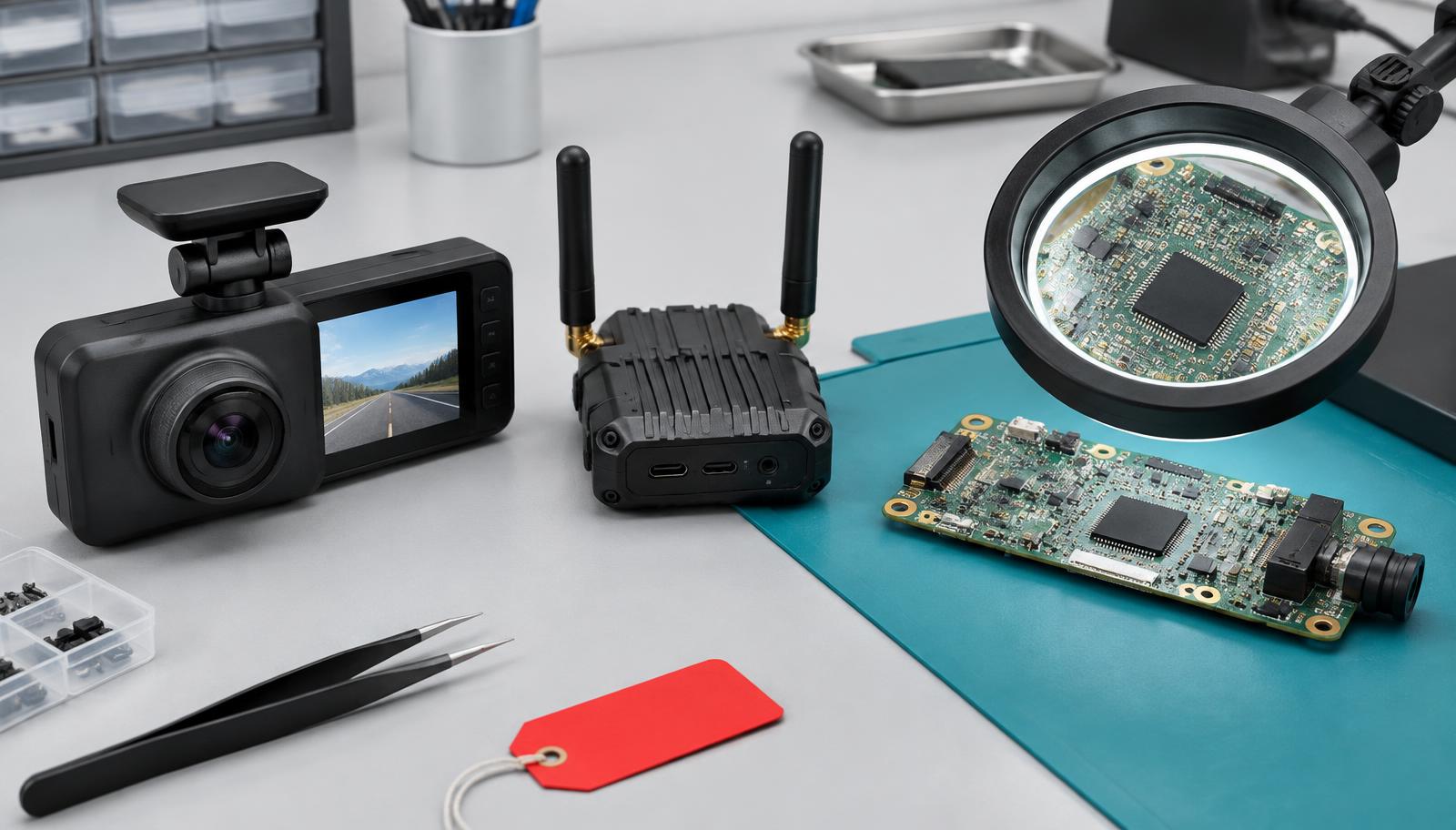
The illustration accompanying this article is also deliberately generic. It shows the kinds of hardware involved, not the actual products at issue. Until product identities and supporting records can be matched reliably, a realistic image must not become another source of mistaken identification.
What to watch next
The most useful follow-up would be specific product and application identifiers, device-specific records explaining the determinations, and any applicant or supplier response. Those would clarify the application histories, how broadly the component finding applies and what a manufacturer would need to change. The announcement establishes that necessary approvals were withheld; it does not provide the two devices’ complete regulatory histories.
Additional actions would also show how the FCC interprets the component threshold in practice. Does scrutiny remain concentrated on video-processing hardware? How are suppliers expected to document a subsidiary relationship or a material component substitution? Those are questions for subsequent records, not conclusions that can be read into the first two cases.
For now, the clear takeaway is narrower than a blanket chip ban and more consequential than a routine certification dispute. The FCC has reported blocking two products because of the restricted supplier behind their internal surveillance hardware. For the US electronics market, the component list is becoming part of the regulatory story.