
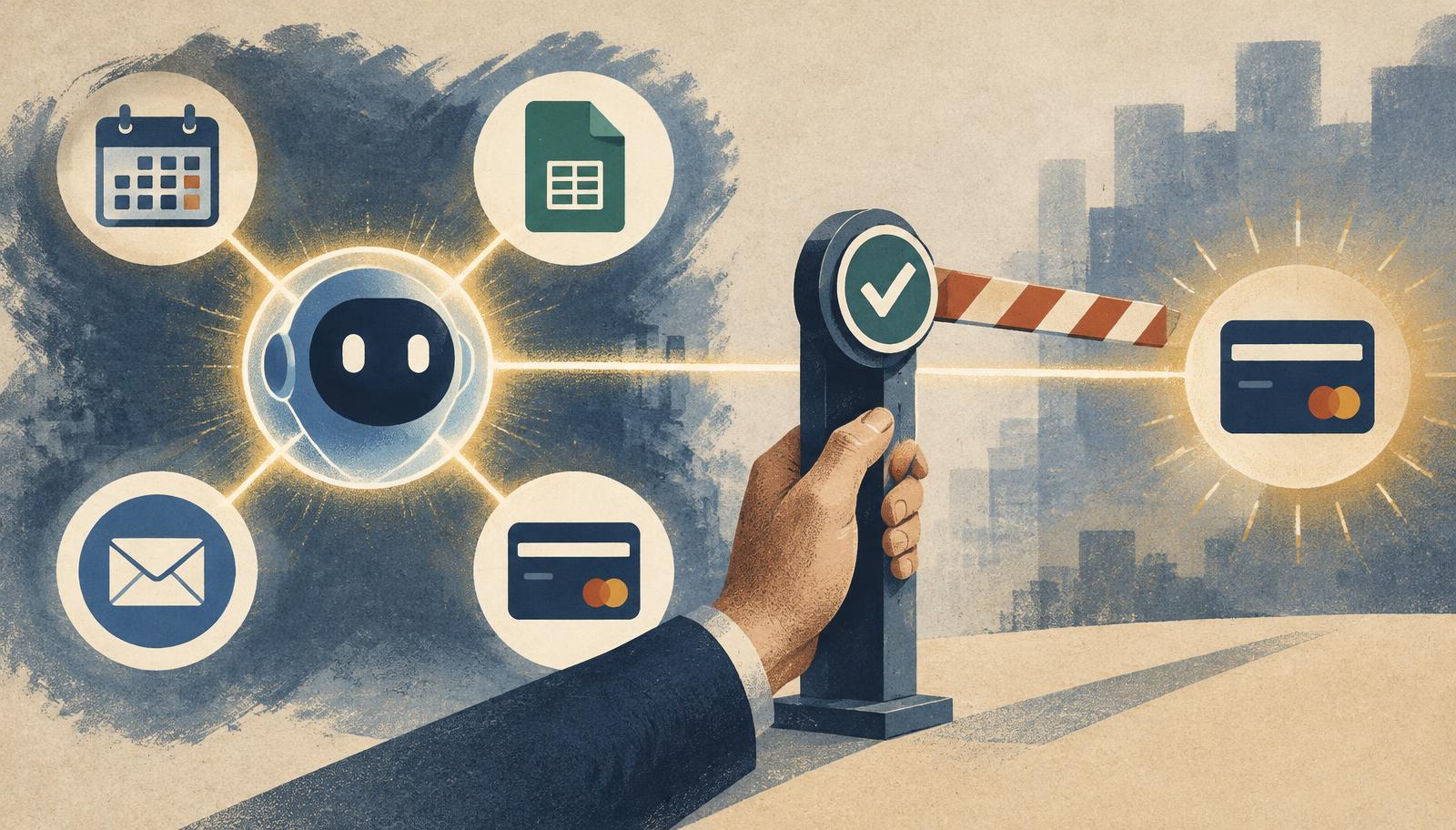
Few technology words have been stretched as far this year as "agent." Vendors apply it to chatbots with a search button, to scheduled automations and to systems that genuinely operate a computer for an hour without supervision. For a business deciding where to spend money, the label matters less than two questions: what can this software be trusted to do on its own, and what happens when it gets something wrong?
This explainer separates the capabilities that are working in production today from those that are still mostly demonstrations, and lays out the risks that security agencies and standards bodies have flagged. It is written for US managers, IT leaders and owners of smaller firms, not for AI researchers.
What an AI agent actually is
A chatbot answers. An agent acts. Technically, an agent is a large language model running in a loop: it reads a goal, decides on a step, calls a tool — a web search, a database query, a code interpreter, an email API — reads the result, and decides the next step until it believes the job is done.
Three ingredients determine how capable and how risky an agent is: the model's reasoning quality, the tools it has been given, and the permissions attached to those tools. An agent that can only read a knowledge base is a research assistant. The same model with authority to send email, issue refunds or merge code is a new kind of employee — one with no judgment of its own about consequences.
Much of 2026's tooling standardizes that plumbing. Anthropic's Model Context Protocol, now supported by OpenAI, Google and Microsoft products, gives agents a common way to connect to business systems. That makes agents easier to build. It also makes it easier to grant them more access than anyone has reviewed.
What agents can reliably do today
Software engineering is the clearest success. Coding agents can read a repository, make changes across files, run tests and open a pull request. The work is suited to agents because results are checkable: tests pass or fail, and a human reviews the diff. Even here, evidence is mixed — a 2025 randomized trial by the research group METR found experienced open-source developers were 19% slower with AI tools on their own projects, while other field studies found gains. Our AI coding tools analysis covers that debate.
Research and synthesis is the second. "Deep research" features from OpenAI, Google and others run dozens of searches and produce a cited report in minutes. They save real time on a first draft, but citations still need checking; agents can misread a source or lean on a weak one.
Routine, rules-bound operations are the third: triaging support tickets, drafting replies for approval, reconciling records between two systems, filling forms from documents, and answering employee questions from internal policies. These work best when the process is already documented and when a mistake is cheap and visible.
How long can an agent work on its own?
METR has tracked one useful measure: the length of task, measured by how long it takes a skilled human, that an AI agent can complete with 50% reliability. In its March 2025 study the group found that horizon had been doubling roughly every seven months since 2019, reaching about an hour for the best models at the time, with later models extending it further.
Two caveats matter for business readers. First, 50% reliability is a coin flip — far below what most processes tolerate. At 80% reliability the horizon is several times shorter. Second, the measured tasks are mostly software and research problems with clear answers. Messy, ambiguous real-world work — a procurement dispute, an angry customer, a regulatory filing — is harder.
The practical reading: agents are good at tasks a competent person would finish in minutes, are improving quickly on hour-long tasks, and are not yet dependable substitutes for multi-day projects without checkpoints.
Computer-use agents: impressive, still brittle
A newer category operates a browser or desktop the way a person would — clicking, typing and reading the screen. OpenAI's ChatGPT agent, Anthropic's computer use and Google's Gemini agent features can book reservations, compile spreadsheets from websites or complete web forms.
These systems are slower than direct integrations and fail in unglamorous ways: a pop-up, a changed layout, a CAPTCHA, a login timeout. On public benchmarks such as OSWorld, top agents have improved sharply but still trail humans on ordinary office tasks. They are worth piloting for occasional chores on sites without an API; they are not yet a foundation for critical workflows.
Where businesses should be careful
Prompt injection is the central security problem. An agent cannot reliably distinguish instructions from its owner and instructions hidden in the content it reads — an email, a web page, a PDF, a calendar invite. OWASP ranks prompt injection as the top risk for LLM applications, and the UK National Cyber Security Centre has warned it may never be fully solved the way SQL injection was. An agent that reads untrusted content and also holds sensitive permissions can be tricked into leaking data or taking actions.
Security researcher Simon Willison describes the most dangerous combination as a "lethal trifecta": access to private data, exposure to untrusted content, and the ability to send information out. Any agent with all three should be treated as exploitable unless it is tightly constrained.
Excessive permissions are the second risk. Agents are often connected with an employee's own credentials or broad service accounts. If the agent is fooled or simply wrong, it acts with all that authority. Our guide to AI-powered cyberattacks explains why identity controls already matter so much.
Confident errors are the third. Agents can report success on a task they did not finish, invent a figure, or quietly skip a step. Unlike a person, they rarely say "I'm not sure." Cost is a fourth, quieter risk: long agent runs consume many model calls, and a loop that retries a failing step can generate a surprising bill.
Legal and regulatory exposure in the US
There is no single federal AI agent law, but existing rules apply to what agents do. The FTC has said repeatedly that there is no AI exemption from consumer-protection law, and its 2024 "Operation AI Comply" actions targeted deceptive AI claims. A company remains responsible for statements its agent makes to customers — a principle a Canadian tribunal applied in 2024 when Air Canada was held to a refund policy its chatbot invented.
Sector rules matter more: fair-lending and adverse-action requirements for credit decisions, HIPAA for health data, and state privacy laws such as California's. Colorado's AI Act, now scheduled to take effect in June 2026 after a delay, adds duties for "high-risk" automated decisions in employment, housing, lending and similar areas. Our article on US banking regulators and AI shows how supervisors are applying existing model-risk guidance.
A practical control checklist
1. Start with one bounded process where mistakes are visible and reversible, and write down what "done correctly" means.
2. Give the agent its own identity with least-privilege access — read-only wherever possible — rather than a person's login.
3. Require human approval for irreversible actions: payments, refunds, outbound customer messages, deletions, contract terms and production deployments.
4. Separate untrusted content from sensitive tools. An agent that reads inbound email should not also be able to export customer records.
5. Log every tool call and keep the logs where the agent cannot alter them.
6. Set spending, rate and time limits, plus a simple kill switch.
7. Measure accuracy on a sample of real cases before and after launch, and re-test when the vendor changes the model.
8. Ask vendors where data is processed, whether it trains their models, and how they defend against prompt injection. NIST's AI Risk Management Framework and its generative-AI profile (AI 600-1) give a useful structure for those questions.
What this means for smaller businesses
Small firms do not need an agent platform to benefit. The highest-return uses are often the most modest: an assistant that drafts quotes from a template, summarizes inbound inquiries, or prepares bookkeeping entries for a human to approve. The same principle applies at any size — let the agent prepare, and let a person commit.
Be cautious with browser extensions and "connect your inbox" offers from unfamiliar vendors. Granting an agent access to email, file storage and payment accounts concentrates risk in one place.
The bottom line
AI agents in 2026 are real and useful, but narrower than the marketing suggests. They are strongest where work is short, well defined and easy to check, and weakest where they must judge untrusted information while holding real authority. Businesses that treat agents like a capable new hire on probation — limited access, supervised decisions, reviewed results — will capture most of the benefit with a fraction of the risk.
For the device side of this trend, see our explainer on on-device AI agents.
Frequently asked questions
Is an AI agent the same as a chatbot? No. A chatbot produces text in response to you; an agent uses tools to take actions and can work through several steps without a prompt at each one.
Can AI agents replace employees? For whole jobs, generally not yet. They can absorb specific tasks, which changes how work is divided, but they still need people to set goals, handle exceptions and check results.
What is prompt injection? It is when instructions hidden in content an agent reads — a web page or email — hijack its behavior. There is no complete fix, so limiting what a compromised agent can do is essential.
What is the safest first project? A read-only or draft-only task, such as summarizing tickets or preparing reports, where a person reviews output before anything leaves the company.