
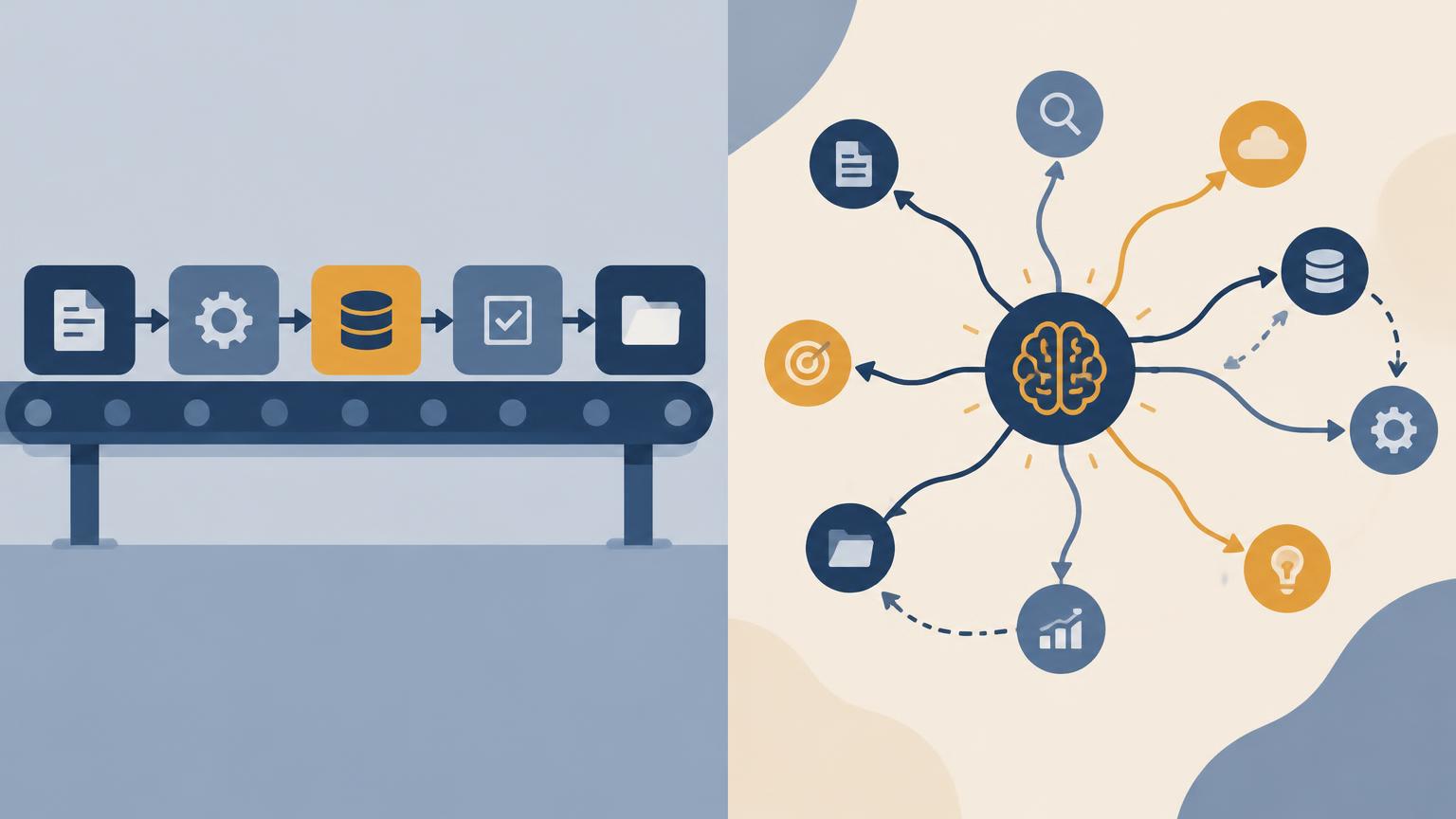
Walk through any business-software conference this year and you will hear the words "automation" and "agent" used almost interchangeably. A vendor demonstrating a simple if-this-then-that workflow calls it an agent. Another sells a genuinely autonomous system and calls it automation. The confusion is not accidental — "agent" is the word of the moment, and it sells.
For a US business deciding where to spend money, the distinction is not semantic. The two approaches differ in what they can do, what they cost to run, how they fail and what kind of oversight they need. Buying an agent where automation would do wastes money and adds risk. Buying automation where judgment is needed produces a system that breaks the first time reality deviates from the script. This explainer draws the line, shows where each fits, and explains what has actually changed in 2026.
What AI automation means
Automation, in the sense businesses have used it for two decades, means encoding a process as fixed rules. A trigger fires — an invoice arrives, a form is submitted, a stock level drops — and the system executes the same steps every time: read these fields, check this condition, update that record, send this email. Robotic process automation, or RPA, extended the idea to software that mimics clicks and keystrokes in applications that have no proper integration.
Modern "AI automation" adds machine learning at specific points inside that fixed flow. A document-processing pipeline might use a model to read an invoice's line items, but the pipeline itself — where the file goes, who approves it, what happens on a mismatch — is still designed in advance by a person. The AI handles a perception task; the process remains a script.
The defining properties follow from that design. Automation is deterministic or close to it: given the same input, it does the same thing. It is cheap per execution, fast, and straightforward to audit, because every possible path was drawn on a diagram before launch. Its weakness is brittleness. A supplier changes an invoice layout, a customer asks something outside the decision tree, a website moves a button — and the automation either stops or, worse, does the wrong thing confidently.
What an AI agent means
An AI agent replaces the fixed script with a model that plans. Given a goal — "reconcile this month's expenses," "research these five suppliers," "handle this support ticket" — the agent decides what to do next, calls a tool such as a search engine, database, email or business application, reads the result, and chooses the following step. It loops until it judges the task complete. Our earlier explainer on what AI agents can actually do covers the mechanics in detail.
The practical difference is how the system handles the unexpected. When an automation hits a condition its designer did not anticipate, it fails. When an agent hits one, it improvises — it tries another search, re-reads the document, asks a clarifying question or routes around the obstacle. That flexibility is exactly what makes agents useful for work that is too variable to script, and exactly what makes them harder to trust.
Because the model chooses the path, the same task can take a different route each time. Results need checking rather than assuming. Costs vary with how much thinking the task required. And because agents often read untrusted content — emails, web pages, documents — they inherit security problems, like prompt injection, that a closed automation pipeline never faces. OWASP ranks prompt injection as the top risk for language-model applications, and there is no complete fix.
The spectrum in between
Real products in 2026 rarely sit at either pole. Anthropic, which publishes unusually clear guidance on this, draws the line between "workflows" — systems where models and tools are orchestrated through predefined code paths — and "agents," where the model directs its own process. Most useful business systems are workflows with agentic steps, or agents wrapped in workflow guardrails.
A customer-service system is a typical hybrid. The routing, logging and escalation rules are automation. The part that reads an angry, rambling email, works out what the customer actually wants and drafts a reply is agentic. The decision about whether to issue a refund over a set amount goes back to a fixed rule or a human. Knowing which parts of your own process are which is the first step to buying the right tool.
A useful test: if you can draw the entire process as a flowchart in advance, it is automation, and you should buy and price it as automation. If the value comes precisely from not being able to draw the flowchart — because inputs are unpredictable and the right response depends on context — you are in agent territory, with everything that implies for cost and control.
Why the difference matters for buyers
Cost structure is the first reason. Automation platforms typically charge per robot, per workflow or a flat subscription, and each execution costs fractions of a cent in computing. Agents charge by model usage, and a single task can involve dozens of model calls. A process that costs $50 a month to automate can cost hundreds of dollars a month to run as an agent. For stable, high-volume work, that premium buys nothing.
Risk profile is the second. When automation fails, it fails in ways its designer can enumerate — a rejected file, an error queue, a stopped job. When an agent fails, it can fail in ways nobody enumerated: it misreads a situation, invents a plausible-looking answer, or follows instructions hidden in content it was asked to read. The failure modes of automation are operational; the failure modes of agents are closer to those of a new employee, which is why our guide to agent risks for businesses recommends least-privilege access and human approval for irreversible actions.
Auditability is the third, and it matters increasingly to US regulators. An automated decision can be replayed against its rules. An agentic decision requires logging every model call and tool action to reconstruct what happened — and even then, the reasoning is a statistical artifact, not a rule you can point to. In regulated areas such as lending, employment and health, where decisions must be explainable, that difference is not academic. The FTC has made clear there is no AI exemption from existing consumer-protection law, and Colorado's AI Act, scheduled to take effect in June 2026, adds duties for high-risk automated decisions.
Why the difference matters in 2026 specifically
Three things changed recently. First, the plumbing standardized. Protocols such as the Model Context Protocol, now supported across OpenAI, Google, Microsoft and Anthropic products, give agents a common way to connect to business systems. Connecting an agent to your tools is far easier than it was two years ago — which means the bottleneck has moved from "can we connect it" to "should we, and with what permissions."
Second, capability crossed a threshold for bounded work. Research from METR shows the length of task an agent can complete reliably has been doubling roughly every seven months, and coding agents in particular now handle multi-step work that was demonstration-only in 2024 — though evidence on net productivity is genuinely mixed, as our analysis of AI coding tools documents.
Third, the marketing ran ahead of the engineering. Gartner predicted in 2025 that over 40% of agentic AI projects would be canceled by the end of 2027, citing escalating costs, unclear business value and inadequate risk controls — and warned that many vendors were engaged in "agent washing," relabeling chatbots and RPA as agents. That prediction is the strongest argument for learning the distinction: the businesses most likely to be disappointed are the ones that bought a relabeled script expecting autonomy, or bought autonomy for a job that needed a script.
How to decide which one a task needs
Ask four questions about the process. How variable are the inputs? If every case looks roughly the same, automation wins. How costly is a wrong action? If errors are expensive or irreversible, prefer automation's predictability or keep a human in the loop. How often does the process itself change? Rules that change weekly are painful to maintain as automation but natural for an agent that reads current instructions. And does the task require judgment about ambiguous, unstructured information — tone, intent, context? That is the agent's home ground.
Then check the math. Estimate the volume of tasks, multiply by the per-task cost of each approach, and compare against the cost of errors. For many back-office processes the honest answer is that well-built automation plus a person handling exceptions beats an agent on both cost and reliability. Agents earn their premium where the exceptions are the norm.
Finally, be skeptical of the label on the box. Ask the vendor to show, on a live task, what happens when inputs deviate from the demo. Ask whether the system follows predefined paths or chooses its own. Ask what it costs per completed task at your volumes, not per seat. A vendor who cannot answer those questions clearly is selling the word, not the capability.
Security and control differences
Automation's security model is conventional: it holds credentials, it touches systems, so you protect the credentials and review the integrations. The blast radius of a compromise is whatever the workflow was built to do.
Agents widen that surface because they act on content they read. An agent that processes inbound email and can also query your customer database can be instructed, by a stranger's email, to do things you never asked for. Security researcher Simon Willison calls the dangerous combination — access to private data, exposure to untrusted content, and a way to send data out — the "lethal trifecta," and advises treating any agent with all three as exploitable unless tightly constrained. Our coverage of AI-powered cyberattacks shows why identity and permission controls matter more as these systems spread.
The practical controls mirror the difference. For automation: change management, because someone must approve every rule change. For agents: least-privilege tool access, logging of every action, spending limits, and human approval gates on anything irreversible — payments, deletions, outbound messages to customers.
Where this is heading
The likely end state is not agents replacing automation but the two fusing into layered systems: deterministic automation for the stable skeleton of a process, agents for the variable tissue around it, and people at the points where money, customers or legal exposure are involved. That architecture is already visible in the more mature deployments of 2026.
It is also worth expecting the vocabulary to keep shifting. As agents become ordinary, vendors will find a new word. The questions in this article — who decides the steps, what does an error cost, how do you audit it — will outlast whatever the next label is.
Frequently asked questions
Is robotic process automation the same as an AI agent? No. RPA replays recorded clicks and keystrokes along a fixed path. An agent decides its own steps using a language model. Some vendors now embed models inside RPA products, which creates hybrids, but the core distinction — predefined path versus model-chosen path — still holds.
Which is cheaper to run? For stable, high-volume tasks, automation is far cheaper — often fractions of a cent per execution versus potentially dozens of paid model calls for an agent. Agents can be cheaper than automation only when the alternative is building and maintaining hundreds of brittle rules for highly variable work.
Can an agent replace our existing automations? Usually it should not. If an automation works reliably, an agent adds cost and unpredictability without adding value. Agents are best deployed where automation was never feasible because the work could not be fully scripted.
How do I know if a vendor is "agent washing"? Ask for a live demonstration with inputs the vendor has not seen, and ask what happens when the task goes wrong. A genuine agent adapts its plan; a relabeled script follows its flowchart or fails. Also ask how the product is priced per completed task — true agentic systems have variable, usage-based costs.