
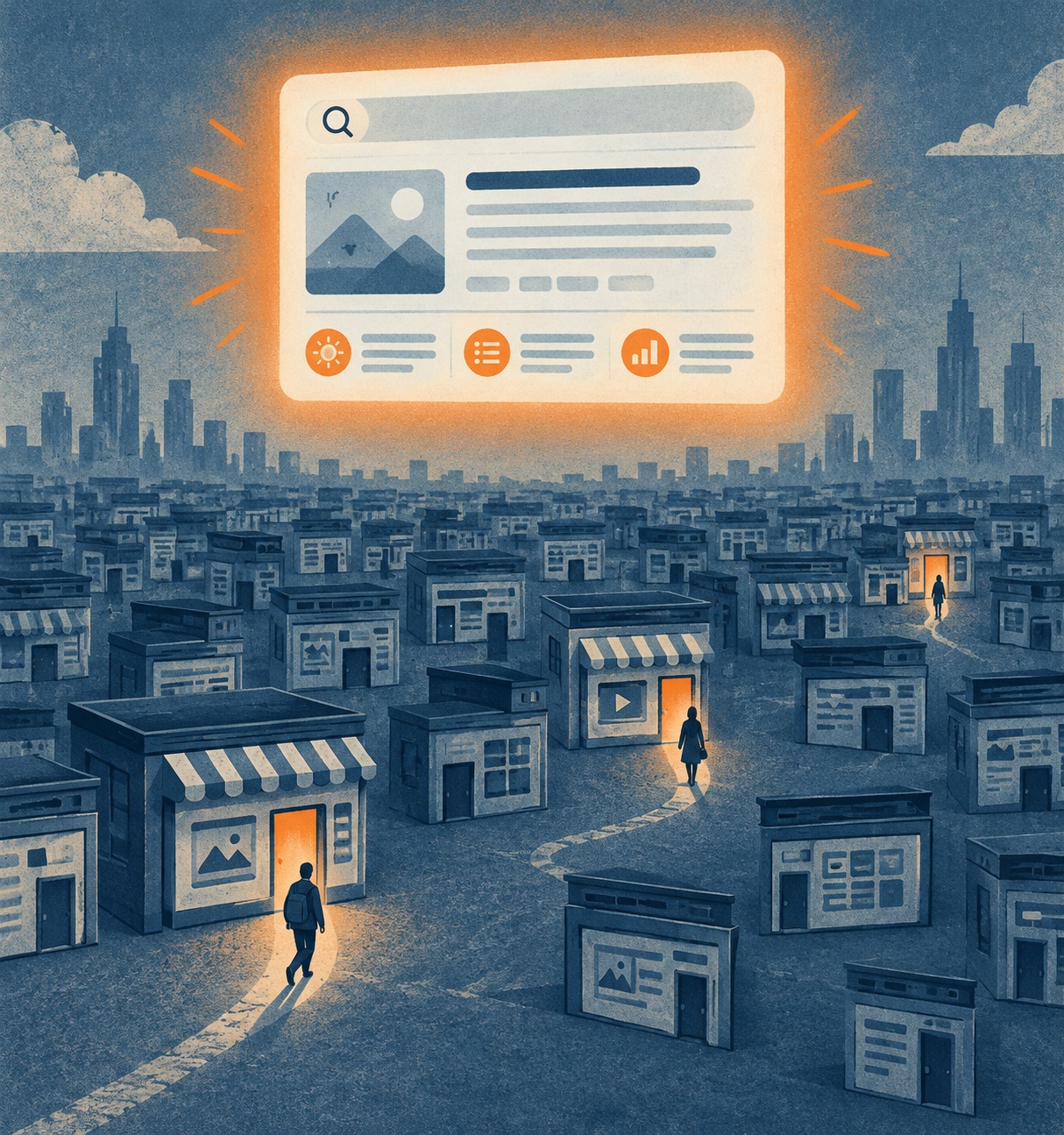
The answer arrives. The visitor does not.
A homeowner asks why an air conditioner freezes up. A small-business owner asks what goes into a cybersecurity incident plan. A reader wants the difference between two laptop processors. Each question once offered a straightforward opportunity for a specialist website: answer it clearly, earn a search visit, and perhaps gain a customer or subscriber.
Now the search interface can assemble an answer before the reader opens any of those sites. The source may be credited. Its work may shape the explanation. Yet the visit that pays for the work may never happen. That is the central tension behind the phrase ‘clickless internet’: a more convenient information experience for the reader can be a less sustainable distribution system for the producer.
The phrase is not a literal claim that links have disappeared. People still need to buy things, book appointments, inspect documents and verify consequential advice. The question is how much of the journey happens before they reach a website—and which businesses can survive the change.
Zero-click search was here before generative AI
Weather cards, calculators, maps, sports scores and short answer boxes already let people complete searches without opening an outside page. Some searches are navigation inside the search product. Others end because the person abandons the task. ‘No click’ therefore does not automatically mean an AI answer replaced a publisher.
Generative AI broadens the kinds of questions that can be resolved on the results page. Google says AI Overviews and AI Mode may use query fan-out: multiple related searches across subtopics and sources to develop an answer. A comparison that once required several tabs can become one explanation with follow-up questions. That description comes from Google; it is not an independent accuracy assessment. 2
Three different outcomes can follow: a user gets a complete answer and leaves; a user follows a citation to inspect the evidence; or a user changes the question and continues inside the assistant. Calling all three ‘AI traffic’ hides the difference between being used as a source and actually receiving a person.
What the U.S. evidence actually shows
Pew Research Center analyzed browsing records from 900 U.S. adults during March 2025. Its dataset contained 68,879 unique Google searches. Researchers collected corresponding results pages in April, identifying 12,593 searches that produced an AI summary. Traditional result links were clicked in 8% of visits associated with a summary, compared with 15% without one. Links inside the summaries received clicks in 1% of visits to pages with a summary. 1
The traditional-result gap is seven percentage points. Expressed relative to the 15% baseline, it is about 47%: (15 − 8) ÷ 15 × 100. That is a calculation from two observed rates—not proof that turning on an AI summary cuts an individual website’s traffic by 47%.
Pew also found that browsing sessions ended after 26% of pages with a summary, versus 16% without one. Its definition of ending a session included exiting the browser for at least five seconds. Those details matter when someone turns a behavioral observation into a headline about the death of the web. 1
| Observed behavior | With AI summary | Without AI summary |
|---|---|---|
| Clicked a traditional result | 8% | 15% |
| Clicked a link in the summary | 1% | Not applicable |
| Ended the browsing session | 26% | 16% |
Why that study is not a universal traffic forecast
The study was observational, not a randomized trial showing identical queries with and without summaries. Longer, question-like searches were more likely to produce summaries, meaning the two groups could differ in intent. Search pages were reconstructed after the browsing period, and summaries can change. The analysis covered Google, not every assistant or search engine. 1
It is strong evidence for a narrower point: in this sample and period, summaries were associated with less clicking to traditional results, and citation clicks were uncommon. It does not establish today’s rate for a local contractor, a software vendor or a national newsroom. This article uses the 2025 observations as evidence of the mechanism, not as newly measured 2026 behavior.
A site losing visits also needs to consider ranking changes, seasonality, competition, tracking failures and changes in demand. AI may be part of the explanation. It should not become the explanation before the other possibilities have been checked.
A citation is not a visit—and a mention is not a citation
An AI answer can name your company without linking to it, link to a page without attracting a click, or summarize your material without clearly identifying it. These are different forms of exposure. A citation is a path to a source; a brand mention is recognition inside the answer; a referral is an actual arrival at your site.
None alone proves commercial value. A mention can be inaccurate. A citation can point to an irrelevant page. A visitor can leave without doing anything useful. For decision-makers, the useful sequence is exposure, qualified visit, meaningful action and business outcome—not a single screenshot showing that a model said the brand name.
This is also why monitoring answers requires a repeatable method. Record the question, product, date, location and account conditions. Separate factual errors from missing mentions. A small set of handpicked prompts is not the whole search market, and a fluctuating answer is not a stable ranking.
Related: how AI search engines retrieve and cite information
Who has the most to lose?
Our analysis is that easily summarized information is especially exposed: definitions, basic troubleshooting, short comparisons and routine factual questions. If the entire value of a page fits into a paragraph, an answer interface can deliver much of that value without a visit. This is a business-model inference, not a measured industry-wide ranking of losses.
An advertising-supported publisher loses an opportunity to show an advertisement when no page loads. An affiliate site can lose the outbound purchase journey. A local service business may lose an introductory visit while still gaining a later phone call. A software company may see fewer educational visits but continue to receive demo requests from people who have already done preliminary research elsewhere.
Original reporting is not immune. A summary can convey its finding while stripping away the interview, uncertainty and corrections that give it meaning. Even when a reader benefits, there remains a financing question: who pays to produce the next report if distribution increasingly consumes the result without sending readers back?
Fewer clicks can be better clicks—but only if the numbers work
Google says it has seen higher-quality clicks from results pages with AI Overviews, describing users as more likely to spend time on the destination site. That is Google’s characterization; it is not a guarantee of higher sales or enough additional engagement to compensate for lost volume. 2
Consider an illustrative business with 1,000 visits and a 2% inquiry rate: it gets 20 inquiries. If visits drop to 600 and the rate rises to 3%, inquiries fall to 18. The conversion rate improves while the total outcome worsens. The arithmetic is 1,000 × 0.02 = 20 and 600 × 0.03 = 18; these are invented teaching numbers, not a case study.
Measure qualified inquiries, completed orders, subscriptions and revenue alongside traffic. A publisher may care about returning readers and paid subscribers; a service firm may care about booked jobs. Neither should accept ‘better visitors’ as compensation until its own results support the claim.
What changed in 2026: more visibility reporting
Advice written before 2026 can miss an important development. Google announced dedicated Search Generative AI performance reports in June 2026; its announcement says the insights rolled out worldwide by August 31. The listed information includes impressions, pages, countries, devices for Search, and dates. AI-feature data also remains in the overall performance report. 3
That gives owners a more direct way to inspect exposure than guessing from every drop in ordinary search traffic. But the announcement describes visibility information, not a complete ledger connecting each generated answer to a sale. An impression tells you that a link appeared; it does not tell you that someone read the whole answer, trusted it or bought from you.
Use Search Console alongside site analytics and business records. Compare U.S. traffic separately when that is your market. Break pages into informational, navigational and purchase-oriented groups. Check whether the change is concentrated in a topic, device or period rather than treating the entire site as one undifferentiated number.
A practical traffic audit before changing strategy
Start with consistent reporting periods and verify that analytics tags and consent settings have not changed. Compare the same pages over time, note major updates, and distinguish lost impressions from declining click-through rates. Less visibility and less clicking on similar visibility are different problems.
Next, review a manageable set of real queries. Save the search conditions and whether an AI answer appears. Look for changes in conventional position, the answer’s sources and competitors. This manual sample can help explain patterns, but it is a diagnostic exercise—not a representative estimate of all searches.
Finally, connect the traffic changes to outcomes. Ask customers how they found you, without treating self-reported answers as exact attribution. Track direct visits and branded demand, but do not automatically credit their growth to AI. Browser restrictions, multi-device journeys and delayed purchases leave gaps in any attribution system.
Give readers a reason to leave the answer box
The response is not to hide every useful sentence. Readers still deserve a clear answer. The stronger proposition is something the summary cannot finish for them: a calculator with their inputs, downloadable original data, a documented test, a local eligibility check, an interview, a working demonstration or a service that actually completes the task.
For a U.S. small business, that may mean accurate service areas, real availability and transparent project requirements. For a publisher, it may mean source documents, explainable methodology and sustained reporting on a subject. For a software company, it may mean implementation details and limitations rather than interchangeable claims about productivity.
Build a direct relationship where readers want one: newsletters, subscriptions and useful repeat visits. These are not instant replacements for search traffic. They are ways to avoid depending entirely on a distribution channel whose interface and incentives you do not control.
SEO still matters; no special file buys an AI citation
Google’s guidance says existing SEO fundamentals remain relevant and that there are no additional special optimizations required for AI Overviews or AI Mode. A supporting page must be indexed and eligible for a snippet. Google also says no new AI text file or special schema is necessary, and eligibility does not guarantee inclusion. 2
Keep important information readable, link related pages, make claims traceable and ensure structured data matches what a reader sees. These practices make a site usable and understandable. They are not a mechanism for forcing a model to recommend your brand.
Terms such as AEO and GEO can describe legitimate work on answer quality and monitoring. They can also disguise ordinary publishing behind a new sales pitch. Ask a provider to define its measurement, show repeatable observations and separate promised deliverables from outcomes it cannot control.
Related: evaluating GEO, AEO and AI search visibility providers
Search inclusion and model training are separate choices
Google now documents a Search Console control for inclusion or exclusion from Search generative AI features, including AI Overviews and AI Mode. Its help page says exclusion prevents visible use and linking in those features and therefore removes their impressions and traffic. It also says this control does not govern AI training; Google-Extended is the separate training control described there. 4
OpenAI likewise distinguishes OAI-SearchBot, used for search, from GPTBot, used for foundation-model training. Its documentation says owners can allow the former while disallowing the latter. Blocking a search crawler is a distribution decision, not merely a statement about training. 5
Do not apply a blanket block without understanding what it does. Document the reason, review the provider’s current instructions and measure the consequences. An owner may reasonably prefer less AI exposure, but no control can promise to recover the visits that would otherwise have occurred.
The deeper issue is the economics of useful information
AI search can make research faster and broaden the sources a person encounters. It can also move the consumption of a publisher’s work onto a platform that does not pay for that work through the same visiting-reader model. Both statements can be true without proving that every site is doomed or that every lost visit is harmless.
The sensible response is evidence before panic: distinguish impressions from visits, visits from revenue, and a documented change from a prediction. Invest in material and services people cannot obtain simply by reading a summary. The internet is not becoming literally clickless. It is making the click less automatic—and forcing websites to explain why the next one is worth making.
Frequently asked questions
What is the clickless internet? It is a shorthand for information journeys that finish inside a search result or assistant without an outside website visit. AI answers expand an older zero-click pattern; the term does not mean the web has stopped receiving traffic.
Does an AI citation increase website traffic? It creates an opportunity for a visit, not a guarantee. Pew’s 2025 U.S. study observed clicks on summary links in 1% of visits to pages with summaries. That is a study-specific observation, not a current rate for every platform. 1
Is SEO obsolete? No. Google says its normal SEO fundamentals still apply to its AI search features. Content must remain accessible and eligible, but technical compliance cannot guarantee a citation or a visitor. 2
Can a website measure AI visibility in 2026? Google’s dedicated generative AI reports provide visibility information such as impressions and pages. Combine that with analytics, repeatable answer checks and business outcomes; no single report fully attributes every AI-assisted customer journey. 3
Should publishers block AI crawlers? That depends on their distribution and content-use goals. Search inclusion and training can have separate controls. Review each provider’s documentation before blocking access, and do not assume a training restriction requires removing the site from AI search. 5